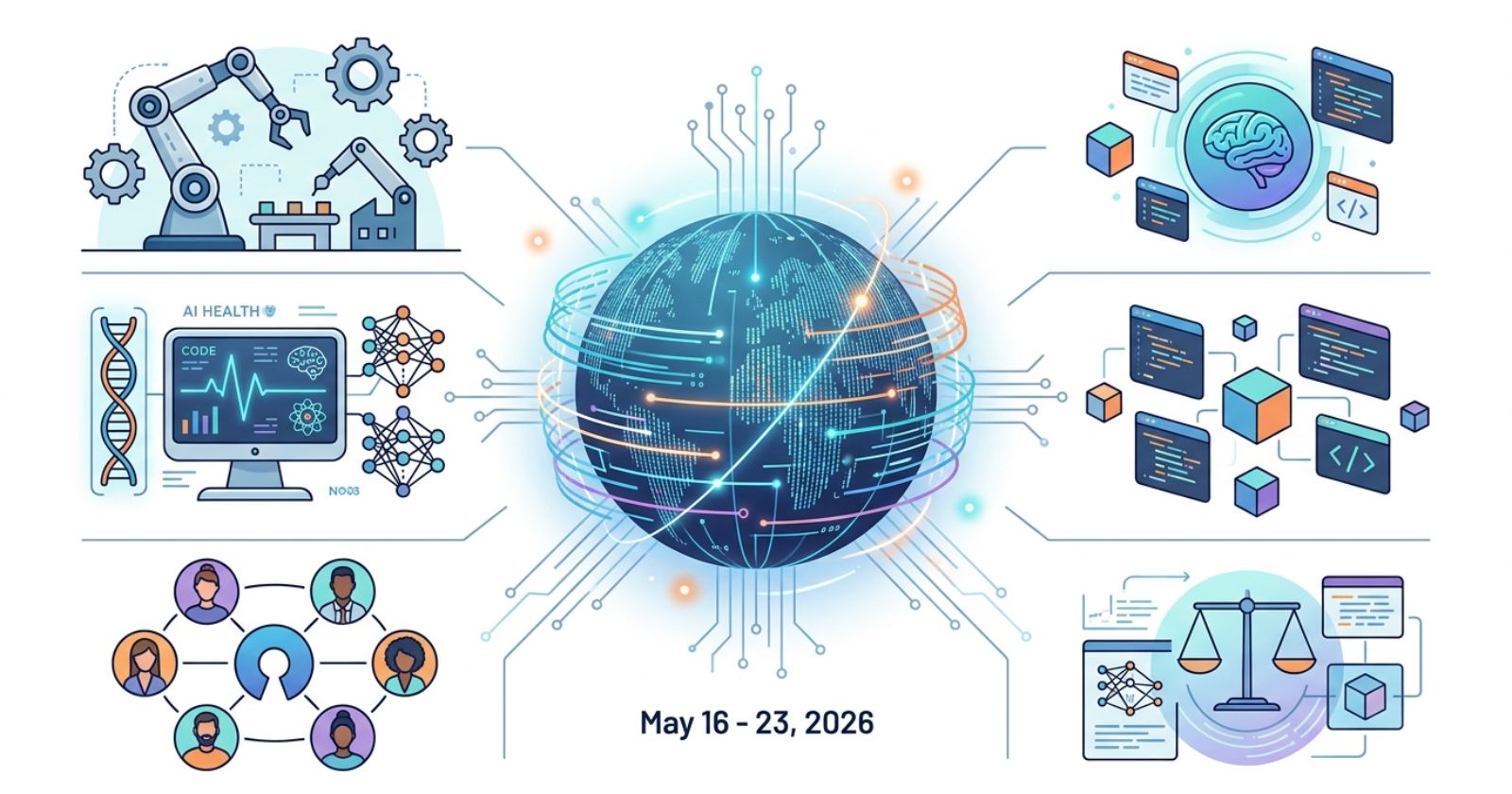
The week of May 16 through May 23, 2026, may be remembered as the most consequential stretch in AI’s short but explosive history. Google ripped apart a search engine it spent nearly three decades building, replacing it with something closer to a persistent autonomous agent.
Anthropic landed one of the most admired AI researchers alive, hired away from his own startup without a press release. OpenAI embedded itself inside the most personal category imaginable: people’s bank accounts.
And a California jury, after less than two hours of deliberation, dismissed Elon Musk’s multi-billion-dollar lawsuit against Sam Altman with a three-word phrase: “statute of limitations.” The velocity of events was staggering even by 2026 standards, and every major storyline carried implications that will reverberate well past this news cycle.
Key Headlines This Week:
- Google I/O 2026: Gemini 3.5, Gemini Spark, and the death of the classic search box
- Andrej Karpathy joins Anthropic’s pretraining team on May 19
- Anthropic in talks to raise $30 billion at a $900 billion-plus valuation
- OpenAI launches ChatGPT personal finance dashboard via Plaid partnership
- Elon Musk loses his OpenAI lawsuit on statute of limitations
- Pope Leo XIV to unveil AI encyclical “Magnifica Humanitas” with Anthropic co-founder
- Anthropic’s Jack Clark predicts AI-assisted Nobel Prize within 12 months
- Meta’s Zuckerberg caught in leaked audio training AI on employees before 8,000 layoffs
- Intuit cuts 3,000 jobs (17% of its workforce) and accelerates AI partnerships
- OpenAI’s ChatGPT ad platform expands globally with self-serve access
- Google’s AI Overviews now reach 2.5 billion monthly users
- Tech industry surpasses 111,000 AI-driven layoffs in 2026
Google I/O 2026: Gemini 3.5, Spark Agent, and the End of Ten Blue Links
Google’s annual developer conference, held May 19 and 20 at Shoreline Amphitheatre in Mountain View, California, delivered what CEO Sundar Pichai called the arrival of the “agentic Gemini era.” The keynote was a dense, nearly two-hour series of announcements that touched every product in Google’s ecosystem. Still, the central thesis was unmistakable: Google is no longer building a search engine. It is building something that searches for you.
Gemini 3.5 Flash, the first model in Google’s newest series, launched the same day. According to Google, it surpasses Gemini 3.1 Pro across coding, agentic, and multimodal benchmarks while running at four times the output token speed of comparable frontier models.
Gemini Omni, a parallel release, accepts image, audio, video, and text inputs and generates video as output, representing a leap in world-model understanding that Google described as the beginning of AI-native media creation. Both models are available immediately through the Gemini app, Google Search, and the Gemini API. Gemini 3.5 Pro, the premium tier of the new family, remains in testing and is expected to reach developers next month.
The headline product, however, was Gemini Spark, a cloud-based personal AI agent that runs on dedicated virtual machines inside Google Cloud. Unlike chatbot-style assistants, Spark is designed to continue executing tasks when a user closes their laptop or phone. It integrates with Google Workspace, third-party apps including Uber and OpenTable, and the open Model Context Protocol (MCP) standard.
Google also introduced the Agent Payments Protocol alongside Spark, a safeguard that limits how much Spark can spend without explicit user approval. The beta opens to US Google AI Ultra subscribers first. Simultaneously, Google’s Search head Liz Reid announced that AI Overviews now reach more than 2.5 billion monthly users, and that Search’s conversational AI Mode has crossed 1 billion users globally, with broader expansion planned for summer 2026.
The $250 Google AI Ultra plan was also repriced at $100, a move that broadens access to the most advanced tier just as Spark becomes available. The competitive signal to OpenAI and Anthropic is clear: Google is no longer treating AI as a feature. It is treating AI as the product.
Source: Google Blog | https://blog.google/innovation-and-ai/technology/developers-tools/google-io-2026-collection/
Andrej Karpathy Joins Anthropic, Shaking Up the Frontier Lab Race
On the same morning Google’s keynote was playing out on screens across Silicon Valley, Anthropic quietly detonated its own announcement. Andrej Karpathy, the 39-year-old Slovak-Canadian researcher who co-founded OpenAI, led Tesla’s Full Self-Driving and Autopilot programs, and most recently founded AI-native education startup Eureka Labs, posted on X at 11:05 AM Pacific on May 19: “Personal update: I’ve joined Anthropic. I think the next few years at the frontier of LLMs will be especially formative. I am very excited to join the team here and get back to R&D.”
Karpathy joins Anthropic’s pretraining team, led by Nicholas Joseph, himself a former OpenAI alumnus. An Anthropic spokesperson confirmed to TechCrunch that Karpathy’s specific mandate is to build a new team focused on using Claude itself to accelerate pretraining research — a strategy that sits at the intersection of AI-assisted science and recursive capability improvement. Pretraining is the most computationally expensive phase of building a frontier model; it determines the baseline knowledge and reasoning capacity of every Claude version that ships. Bringing in someone of Karpathy’s depth to optimize that process, using Claude as a research accelerant, is a direct signal that Anthropic believes AI-assisted research rather than raw GPU scaling is how it competes with OpenAI and Google DeepMind.
The broader pattern around this hire deserves attention. As one widely shared post noted, a series of CTOs from major companies, including Instagram, Workday, Box, and You.com, have taken individual contributor research roles at Anthropic over the past 18 months, accepting significant title reductions to join a lab they believe represents the most consequential frontier. Karpathy’s Eureka Labs educational work appears paused for now; he noted in his announcement post that he remains passionate about education and plans to resume that work in time. His departure from Eureka Labs, which had received backing from prominent investors, is a significant signal about where Karpathy believes the highest-leverage research is happening right now.
Source: TechCrunch | https://techcrunch.com/2026/05/19/openai-co-founder-andrej-karpathy-joins-anthropics-pre-training-team/
Anthropic Eyes $900 Billion-Plus Valuation in Fresh $30 Billion Raise
While Karpathy’s arrival gave Anthropic a talent headline, the company’s financial ambitions produced an equally significant story. Bloomberg reported on May 12 that Anthropic is in early talks with investors to raise at least $30 billion in new capital at a pre-money valuation exceeding $900 billion. The round, which sources indicated could close as soon as the end of May, has not been finalized, and no term sheet has been signed as of the reporting date.
The scale of this potential raise, coming on the heels of Anthropic’s Series G in February 2026 that raised $30 billion at a $380 billion post-money valuation led by GIC and Coatue, reflects the extraordinary revenue trajectory the company has disclosed. In a letter to investors, CEO Dario Amodei revealed that Q1 2026 revenue grew 80 times year-over-year, pushing the company’s annualized revenue rate above $44 billion. The number of customers spending more than $1 million annually on Claude grew from approximately 12 two years ago to more than 500 as of the latest quarter. Enterprise clients, including PwC, Blackstone, and Goldman Sachs, anchor that revenue base.
If this round closes at or above $900 billion, Anthropic would surpass OpenAI’s most recent private market valuation of approximately $852 billion, a milestone that would reconfigure how investors, partners, and competitors think about the frontier AI hierarchy. Google has committed $10 billion in additional investment to Anthropic, with up to $30 billion more contingent on specific technical performance milestones. Amazon has committed $5 billion at the same $350 billion valuation with plans to add another $20 billion over time. Bloomberg also reported that Anthropic is exploring an initial public offering as early as October 2026, which would make it one of the most anticipated technology IPOs in years.
Source: Bloomberg | https://www.bloomberg.com/news/articles/2026-05-12/anthropic-in-talks-to-raise-30-billion-at-900-billion-valuation
OpenAI Brings ChatGPT Inside Your Bank Account with Plaid Partnership
On May 15, OpenAI launched a preview of a personal finance experience inside ChatGPT, available initially to Pro subscribers in the United States on web and iOS. The feature allows users to connect accounts from more than 12,000 financial institutions, including Chase, Fidelity, Schwab, Robinhood, American Express, and Capital One, through a partnership with Plaid, the financial data aggregator.
Once accounts are linked, ChatGPT generates a live dashboard covering spending habits, portfolio performance, active subscriptions, and upcoming payments. Users can then ask context-aware questions, such as “Help me build a plan to buy a house in my area within five years” or “What changed in my spending this month?” rather than relying on generic financial advice. OpenAI’s product page noted that over 200 million people already bring personal finance questions to ChatGPT monthly; the new feature grounds those conversations in verified account data. Support for Intuit is planned for a future update, which would eventually allow ChatGPT to connect tax estimates, credit approval probabilities, and access to financial experts directly within the app.
The origin story adds context. OpenAI acquired the team behind personal finance startup Hiro in April 2026; Hiro was backed by Ribbit Capital, General Catalyst, and Restive before the acqui-hire. The phased rollout is deliberate, with OpenAI limiting access to Pro users first to gather real-world feedback before expanding to Plus subscribers. For the banking and fintech sector, the implications extend beyond a product launch. American Banker noted that the feature could meaningfully shift where consumers form relationships with their financial information, pulling daily engagement away from traditional banking apps and toward ChatGPT as a financial interface. PitchBook fintech analyst Rudy Yang told the publication: “Personal finance has been one of the most talked-about use cases for generative AI since the beginning.”
Source: OpenAI | https://openai.com/index/personal-finance-chatgpt/
Elon Musk Loses His OpenAI Lawsuit in Under Two Hours of Deliberation
The most legally consequential AI news of the week arrived on May 18, when a nine-member federal jury in Oakland, California, unanimously ruled that Elon Musk waited too long to file his lawsuit against OpenAI, Sam Altman, Greg Brockman, and Microsoft. Judge Yvonne Gonzalez Rogers of the US District Court for the Northern District of California accepted the jury’s finding and dismissed all claims the same morning.
Musk, who co-founded OpenAI with Altman in 2015 before departing, had argued that Altman and the company breached founding promises to operate as a safety-focused nonprofit by pivoting to a for-profit structure. He sought between $78.8 billion and $135 billion in damages, along with Altman’s removal from OpenAI. The jury’s deliberations took less than two hours, focusing on the statute of limitations defense that OpenAI had anchored its case on: any harms Musk may have suffered arose from decisions made before the legal window for filing had opened. During the damages-estimation hearing that the verdict interrupted, Judge Gonzalez Rogers told Musk’s damages expert: “Your analysis seems to be devoid of connection to the underlying facts,” a signal she found the $134 billion figure legally unmoored.
Musk posted on X that the outcome was a “calendar technicality” and vowed to appeal to the Ninth Circuit. OpenAI and Microsoft’s legal teams each issued statements welcoming the dismissal. The trial itself, which featured testimony from Altman, Brockman, Microsoft CEO Satya Nadella, and Musk himself, had generated weeks of damaging disclosures about OpenAI’s internal history. But the legal loss is significant beyond individual stakes: it removes a litigation cloud that had the potential to force structural changes at one of the most highly valued private companies on earth. OpenAI is reportedly exploring a public offering, and this verdict eliminates a material legal risk that could have complicated any IPO prospectus.
Source: TechCrunch | https://techcrunch.com/2026/05/18/elon-musk-has-lost-his-lawsuit-against-sam-altman-and-openai/
Pope Leo XIV’s AI Encyclical “Magnifica Humanitas” to Feature Anthropic Co-Founder
One of the most unexpected institutional AI stories of 2026 came from the Vatican. On May 18, the Holy See announced that Pope Leo XIV would personally present his first encyclical, titled “Magnifica Humanitas” (Magnificent Humanity), on May 25, 2026. The document, signed by the Pope on May 15, centers on “the protection of the human person in the age of artificial intelligence” and was chosen to land on the 135th anniversary of Pope Leo XIII’s “Rerum Novarum,” the foundational Catholic social teaching on labor and industrial capitalism.
Among the speakers joining Pope Leo XIV at the formal presentation in the Vatican’s Synod Hall is Christopher Olah, co-founder of Anthropic and the leader of its interpretability research team. Cardinal Víctor Manuel Fernández and Cardinal Michael Czerny, along with theologians Anna Rowlands and Leocadie Lushombo, round out the panel. The choice of Olah is deliberate. Anthropic’s public stance against providing AI capabilities for lethal autonomous weapons and unrestricted mass surveillance of Americans put it in direct conflict with the Trump administration earlier this year, and the company is currently engaged in litigation with the administration over that standoff. Brian Patrick Green, director of technology ethics at Santa Clara University, told the National Catholic Reporter: “Anthropic is the company that has really staked their position as the ethical AI company.”
The Vatican’s decision to frame artificial intelligence as a moral question on par with industrialization, and to invite a frontier AI lab co-founder to stand beside the Pope while presenting that case, marks an unprecedented convergence of religious authority and technology governance. It also draws a sharp line between AI companies that prioritize safety constraints and those that do not, lending institutional moral weight to a distinction that has largely played out in policy circles and press releases. The encyclical arrives at a moment when no major AI regulatory framework has cleared the US Congress, making the Vatican’s moral positioning potentially more culturally resonant than any piece of pending legislation.
Source: Vatican News | https://www.vaticannews.va/en/pope/news/2026-05/pope-leo-xiv-first-encyclical-magnifica-humanitas.html
Jack Clark Predicts a Nobel AI Discovery Within a Year, and Names Existential Risk
Anthropic co-founder Jack Clark delivered a lecture at Oxford University on May 21 that simultaneously offered the most optimistic and most sobering predictions from any senior AI researcher this month. Clark told the audience that AI would collaborate with humans to achieve a Nobel Prize-worthy scientific discovery within 12 months. He projected that AI-run companies would be generating millions of dollars in revenue within 18 months and that bipedal robots would assist tradespeople within two years. By the end of 2028, Clark suggested, AI systems would have the demonstrated ability to design their own successors, a process known as recursive self-improvement.
Clark was equally direct about the downside scenarios. He stated that there remain plausible futures in which the technology has “a non-zero chance of killing everyone on the planet” and called for pandemic-style societal preparation, arguing that late preparation would leave humanity permanently reactive. His comments on recursive self-improvement were grounded in data Anthropic has shared publicly. An April 2026 internal test showed that Claude Mythos Preview achieved 52 times the speed of an unoptimized baseline when tasked with optimizing training code for a small language model, compared to a benchmark of 2.9 times the speed less than a year earlier. Separately, Clark’s newsletter ImportAI, published in May, gave a 60-plus percent probability to an AI model fully training its successor before the end of 2028.
The tension Clark holds in a single lecture, confident near-term optimism paired with genuine existential caution, is not unique to him at Anthropic, but he expresses it with a specificity that most AI executives avoid. The Nobel claim, in particular, is verifiable within a fixed timeframe, which gives it a kind of credibility that more hedged predictions lack. Whether or not a Nobel committee agrees within 12 months, the claim signals that AI leadership at frontier labs believes model capabilities have entered territory that the broader scientific community has not yet fully absorbed.
Source: The Guardian / TechCentral.ie | https://www.techcentral.ie/anthropic-co-founder-predicts-that-ai-will-within-a-year/
Meta’s Zuckerberg Caught on Leaked Audio Training AI on Staff Before 8,000 Layoffs
The most ethically charged story of the week emerged on May 19 and 20, when leaked audio from a Meta internal all-hands meeting surfaced online. The recording, attributed to an April 30 meeting with CEO Mark Zuckerberg, captured him explaining to employees that Meta had been using device-level tracking software to monitor employee activity and feed that data into its AI model training pipeline. “The AI models learn from watching really smart people do things,” Zuckerberg says in the recording.
The timing of the leak was devastating. It surfaced on the same day Meta began notifying approximately 8,000 employees of their terminations, a process that started at 4:00 AM Singapore time on May 20 and rolled through European and US time zones in sequence. Inside Meta’s offices, employees organized a protest, posting fliers on walls urging colleagues to sign petitions against the monitoring program. Zuckerberg, in the audio, sought to reassure staff that the data collection was stripped of identifying information and decoupled from HR performance reviews. “None of the data has been used for looking at what people are doing or surveillance or performance tracking,” he said. Meta has not officially confirmed the recording’s authenticity.
The business logic Zuckerberg described, using highly skilled employee activity patterns as a premium training signal rather than contract-based data labelers, is analytically defensible. The optics, however, of harvesting that behavioral data and then eliminating thousands of the people whose activity generated it, created the kind of narrative that adheres. For the enterprise AI market, the episode raises a disclosure question that no major technology company has fully answered: when employees’ work patterns become training data, what rights of notification and consent apply? Legal and HR experts who spoke with trade publications this week described the current legal framework in the US as largely insufficient to address the practice.
Source: TechStory / Common Dreams | https://techstory.in/leaked-audio-reveals-mark-zuckerberg-defending-internal-employee-tracking-to-feed-metas-ai/
Intuit Cuts 3,000 Jobs and Signs AI Deals with Anthropic and OpenAI
On May 20, Intuit announced it is eliminating approximately 3,000 positions, representing 17% of its global workforce of 18,200 employees across seven countries. CEO Sasan Goodarzi framed the decision in an internal memo as a move to reduce organizational complexity and redeploy capital toward AI product development. The company simultaneously confirmed new partnerships with both Anthropic and OpenAI to integrate AI agents across QuickBooks, TurboTax, Credit Karma, and Mailchimp.
The Intuit cuts are notable on multiple dimensions. At 17%, they represent the largest percentage reduction by a flagship US fintech software company in the 2026 cycle, exceeding Microsoft’s 7% and LinkedIn’s 5%. Affected US employees remain on payroll through July 31 and receive severance packages covering at least 16 weeks of base pay plus two additional weeks per year of service. According to Reuters, Intuit is also closing offices in Reno, Nevada, and Woodland Hills, California. The company’s ties to OpenAI are not incidental: Intuit was listed as an integration partner in the ChatGPT personal finance feature launched on May 15, with support for Intuit’s tax and financial planning services planned as a future capability within that product.
The Intuit announcement landed in the same 48-hour news window as Meta’s 8,000 layoffs, pushing the 2026 tech layoff total past 111,000 according to data from Layoffs.fyi. That pace puts 2026 on track to surpass both 2024 and 2025 in total tech job eliminations. The pattern across all of these companies, Meta, Intuit, Amazon, Cisco, and Microsoft, is structurally consistent: strong revenue combined with accelerated AI investment provides the financial cover and strategic justification for workforce reductions that would otherwise require a deteriorating business context to explain. Whether AI agents can absorb the operational workload of those eliminated roles at the pace companies are implying is the central unanswered question of the 2026 enterprise AI wave.
Source: TechCrunch | https://techcrunch.com/2026/05/20/intuit-to-lay-off-over-3000-employees-to-refocus-on-ai/
OpenAI’s ChatGPT Ad Platform Expands Self-Serve Access Globally
OpenAI’s advertising business, which launched as a closed pilot in late 2025 and began public testing with US Free and Go-tier users in March 2026, reached another commercial milestone this week. As of early May 2026, the company opened ads.openai.com to all US businesses with no minimum spend requirement, adding cost-per-click bidding alongside the original $60 CPM pricing. The self-serve launch followed a May 7 announcement that OpenAI would expand the ad pilot to the United Kingdom, Brazil, Japan, South Korea, and Mexico in the coming weeks.
According to OpenAI’s own disclosure on its ads principles page, the platform uses contextual matching based on current conversation topics, past chat history, and previous ad interactions. Ads appear in clearly labeled boxes below AI responses on Free and Go tiers; Plus, Pro, Enterprise, and Education plans remain ad-free. Major agency partnerships include Dentsu, Omnicom, Publicis, and WPP, with technology integrations from Adobe, Criteo, Kargo, Pacvue, and StackAdapt. OpenAI has projected $2.5 billion in ad revenue for the full year of 2026, a target that industry observers currently consider ambitious given the platform’s recent launch date.
The competitive calculus here is pointed. Anthropic has explicitly positioned Claude as an ad-free alternative, and according to reporting from industry publications, the company ran consumer messaging contrasting its subscription-and-enterprise revenue model with OpenAI’s advertising approach. For marketers, ChatGPT’s 800 million weekly users represent an audience that conversion data from Criteo suggests converts at roughly 1.5 times the rate of other referral channels. The pressure to monetize that audience at scale while preserving user trust in the underlying answers is the defining tension OpenAI now navigates as it moves from a frontier research lab to a global advertising platform.
Source: OpenAI | https://openai.com/index/testing-ads-in-chatgpt/
Key AI Funding and Valuation Data: May 2026 Snapshot
| Company | Round / Event | Amount | Valuation | Date |
|---|---|---|---|---|
| Anthropic | Series G (closed) | $30B | $380B post-money | February 2026 |
| Anthropic | New round (in talks) | $30B+ | $900B+ pre-money | May 12, 2026 |
| OpenAI | Series (completed) | $40B+ | $852B | March 2026 |
| Intuit | Workforce restructuring | N/A | Public company | May 20, 2026 |
| Meta | AI investment / layoffs | N/A | Public company | May 20, 2026 |
Closing
The week of May 16 through May 23, 2026, drew a clear line between the AI industry’s formative years and whatever comes next. Google rebuilt the search engine that funded its rise and replaced it with agents that do the searching. Anthropic recruited the researcher who helped write the first chapter of this technology’s history to help write the next one. A California jury cleared OpenAI’s legal ledger at a critical pre-IPO moment.
And a Pope inviting an AI safety researcher to stand beside him during a moral reckoning with the technology signals that the audience AI now has to answer to extends well beyond regulators and shareholders. The weeks ahead will test whether the products, promises, and predictions of this particular stretch can hold under the weight of everything that has been claimed for them.
Frequently Asked Questions
1. What was announced at Google I/O 2026?
Google I/O 2026, held May 19 and 20, centered on the launch of Gemini 3.5 Flash and Gemini Omni, a new autonomous agent called Gemini Spark, a sweeping redesign of Google Search to incorporate AI Overviews and conversational modes, and the Universal Cart shopping feature. Google also repriced its AI Ultra tier from $250 to $100 per month.
2. Why did Andrej Karpathy join Anthropic instead of returning to OpenAI?
Karpathy announced his move via X on May 19, citing his belief that “the next few years at the frontier of LLMs will be especially formative.” He joins Anthropic’s pretraining team with a mandate to build a new sub-team using Claude to accelerate pretraining research, a capability that aligns with his recent independent work on AI-assisted research automation.
3. What is Anthropic’s current valuation and revenue status?
As of May 2026, Anthropic is in early-stage talks for a new round that would value it at more than $900 billion pre-money. Its annualized revenue rate surpassed $44 billion as of Q1 2026, representing 80 times year-over-year growth. Its February 2026 Series G raised $30 billion at a $380 billion post-money valuation.
4. How does ChatGPT’s new personal finance feature work?
Launched May 15 for US Pro users, the feature connects financial accounts from over 12,000 institutions through Plaid. Once linked, ChatGPT generates a spending dashboard, tracks subscriptions and upcoming payments, and answers context-aware questions grounded in the user’s actual financial data. Intuit integration is planned for a future update.
5. What did the Musk vs. OpenAI verdict mean for the AI industry?
A California jury unanimously ruled on May 18 that Musk’s claims against OpenAI, Altman, Brockman, and Microsoft were barred by the statute of limitations. The dismissal removes a significant legal cloud ahead of a potential OpenAI IPO and eliminates the possibility of a court ordering structural changes to OpenAI’s for-profit entity.
6. Who is Christopher Olah, and why is he presenting at the Vatican?
Christopher Olah is an Anthropic co-founder and the lead of the company’s AI interpretability research team. He will join Pope Leo XIV at the May 25 presentation of “Magnifica Humanitas” because Anthropic’s public stance against military AI applications and mass surveillance has positioned it as the frontier lab most aligned with the Vatican’s emphasis on human dignity and ethical AI deployment.
7. What is Gemini Spark, and how does it differ from previous Google AI assistants?
Gemini Spark is a cloud-based autonomous AI agent that runs on dedicated Google Cloud virtual machines, meaning it continues executing tasks even when a user’s device is off or closed. Unlike previous assistants that required active user interaction, Spark is designed to manage schedules, pull files, write emails, and eventually process payments autonomously, subject to user-defined budget limits enforced through the Agent Payments Protocol.
8. Why did Meta track employee activity to train AI models?
In leaked audio from an April 30 all-hands, Mark Zuckerberg explained that Meta was using device-level monitoring software to capture how skilled employees interact with tools and software, using those behavioral patterns as high-quality AI training data. Zuckerberg argued that employees’ technical competence made them more valuable training sources than contract data labelers. The disclosure came days before approximately 8,000 employees received layoff notifications.
9. What sectors are seeing the most AI-driven job displacement in 2026?
According to data from Layoffs.fyi, over 111,000 technology sector jobs have been eliminated in 2026 through mid-May, on pace to exceed both 2024 and 2025 totals. Enterprise software, fintech, and cloud infrastructure are the most affected categories, with companies including Meta, Amazon, Microsoft, Cisco, Cloudflare, and now Intuit citing AI investment as a driver of workforce restructuring.
10. What does Jack Clark’s Nobel Prize prediction actually mean?
Clark’s prediction, made at Oxford on May 21, is that within 12 months an AI system will collaborate with human researchers to make a scientific discovery worthy of Nobel Prize consideration. He grounds this in Anthropic’s internal benchmarks showing accelerating AI performance on complex research tasks. The prediction is falsifiable within a defined timeframe and carries more epistemic weight than most vague AI capability claims precisely because it is specific enough to be evaluated.