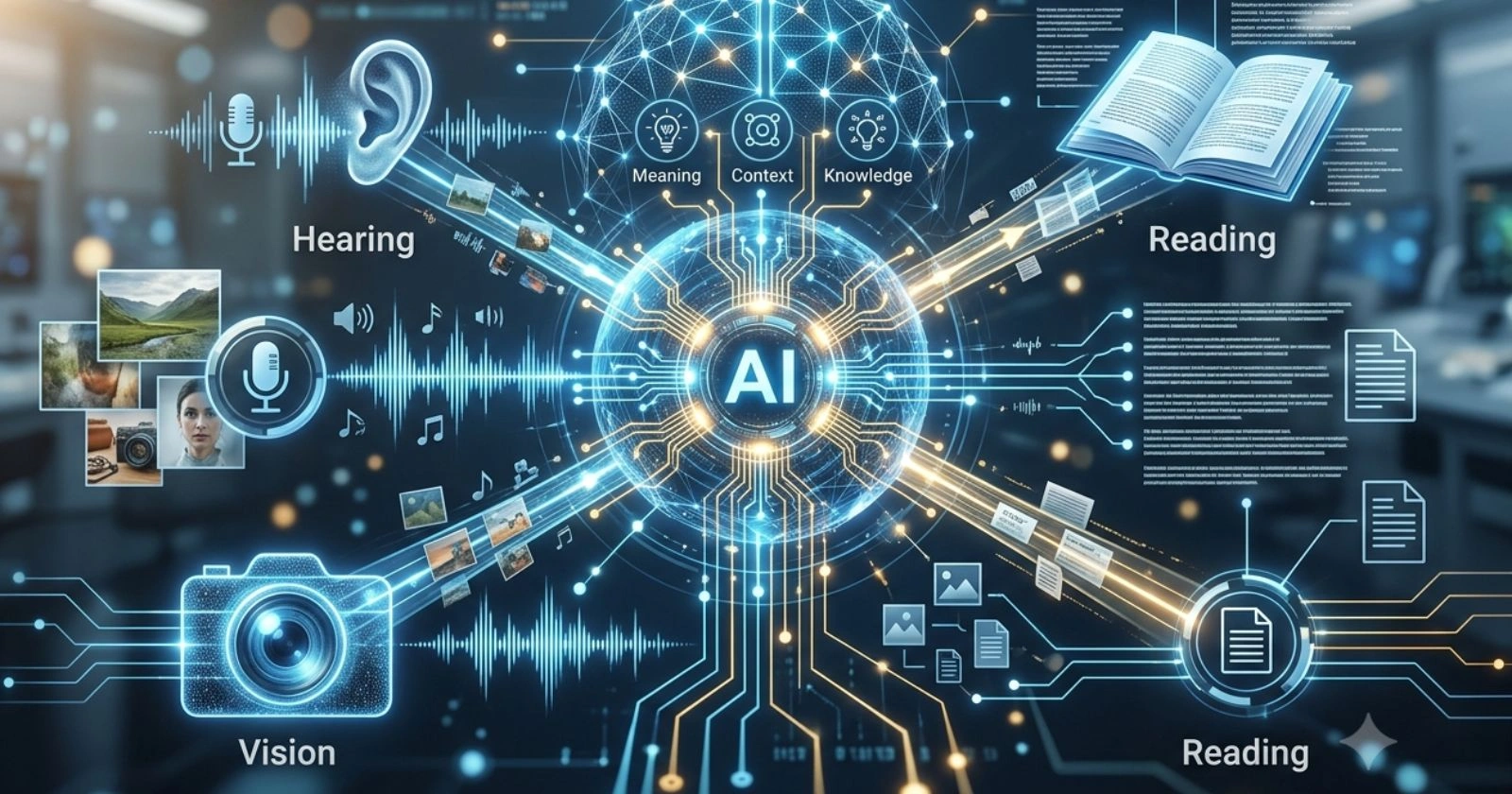
For most of AI’s history, language models did one thing: process text. A separate category of models handled images. Audio required yet another system. These capabilities existed in parallel but rarely in combination. Multimodal AI changes that architecture fundamentally, and understanding what it means in practice is increasingly important for anyone building with or using AI tools professionally.
Multimodal AI refers to systems that process multiple types of input, including text, images, audio, and video, within a single model and produce coherent output that draws on all of them simultaneously. This is not about connecting separate models with pipelines. It is about training a single system to understand and integrate information across modalities as part of a unified reasoning process.
By 2026, the leading frontier models from OpenAI, Google, and Anthropic all offer multimodal capabilities to varying degrees. The practical implications for enterprise applications, creative work, and everyday AI use are significant and still unfolding.
What Makes a Model Truly Multimodal
The distinction between truly multimodal models and systems that appear multimodal is important for practitioners. Earlier systems handled multiple input types by routing them to separate specialized models and combining the outputs. A vision encoder would process an image into text tokens. The language model would then process those tokens. The image was never truly understood in relation to the text; it was translated into text first.
Truly multimodal models use early fusion or native multimodal training, where vision and language tokens are integrated into the model backbone from the beginning of training. Llama 4 uses early fusion. GPT-4o was described by OpenAI as “omni” precisely because it processes text, images, and audio natively in a single system rather than translating between modes.
This architectural difference produces more coherent cross-modal reasoning. When a user asks a question about an image while also providing textual context, a native multimodal model can reason about the relationship between the two inputs directly. A pipeline system reasons about them separately and combines the outputs downstream.
The Leading Multimodal Models in 2026
Three frontier models now lead on multimodal benchmarks. Each dominates different categories.
Gemini 3.1 Pro leads on video understanding with a Video-MME score of 78.2%, outperforming the next competitor at 71.4%. The model also processes audio natively and offers a 1 million token context window that accommodates long-form multimedia inputs. For applications requiring video analysis, meeting transcription combined with visual context, or audio understanding, Gemini currently sets the standard.
GPT-4o and its successors in the GPT-5 family lead on chart and graph understanding, combined with code generation. For tasks where a user provides a data visualization and asks for an explanation or code to reproduce it, GPT-5 models perform at the top tier. The model also introduced genuinely low-latency voice conversation in 2024, enabling natural spoken interaction without the transcribe-then-process pattern of older voice interfaces.
Claude Opus 4.7 leads on long-document OCR and complex document comprehension. For tasks involving dense PDFs, scanned contracts, research papers with embedded figures, or structured forms, Claude’s ability to extract and reason about text and visual layout simultaneously is the strongest among current options.
The 2026 Multimodal Breakdown
The field has split along functional lines. Gemini wins video and audio. GPT-5.5 wins charts and code combined with vision. Claude 4.7 wins long-document OCR and text-heavy multimodal tasks. Understanding this specialization is what allows organizations to route tasks to the right model rather than applying one tool to every multimodal problem.
What Multimodal AI Actually Enables
The practical applications of multimodal AI span industries and job functions. McKinsey’s State of AI Report 2025 found that 65% of large enterprises were actively testing or deploying multimodal AI technologies in production environments, with the highest-ROI use cases concentrated in three categories.
Document intelligence is the largest category: extracting structured data from invoices, contracts, medical records, and financial statements. Previously, this required either manual data entry or OCR pipelines combined with separate parsing systems. Multimodal models handle the extraction end-to-end, reading layout, tables, handwritten annotations, and printed text together.
Visual quality inspection in manufacturing uses multimodal AI to detect product defects by analyzing images against specifications. Systems that previously required custom computer vision models trained on labeled defect data can now be implemented with a general-purpose multimodal model that understands natural-language descriptions of what a defect looks like.
Voice and screen AI assistants represent the third high-ROI category. Systems that can see what is displayed on a screen while simultaneously hearing a spoken question can answer questions about the current context without requiring users to describe it in text. Customer service, technical support, and accessibility applications are early adopters of this capability.
Multimodal AI for Individual Professionals
Beyond enterprise use cases, multimodal AI changes daily workflows for individual knowledge workers in concrete ways.
Professionals who work with slide decks, charts, and reports can ask multimodal models to interpret data visualizations and produce written summaries directly from screenshots or uploaded documents. This eliminates the manual step of describing what a chart shows before asking for analysis.
Researchers can upload papers with embedded figures and equations and ask questions about the content. The model processes text and figures together, maintaining the relationship between a referenced figure and the surrounding argument rather than treating them as separate artifacts.
Developers can share screenshots of error messages or user interface states and ask for a diagnosis. The model sees both the visual state and any accompanying text, producing more contextually accurate responses than text-only debugging assistance.
Limitations Worth Understanding
Multimodal AI in 2026 has meaningful limitations that users should understand before deploying these capabilities.
Audio understanding, while improving rapidly, still struggles with overlapping speakers, strong accents, and low audio quality. Automated meeting transcription with multiple participants still produces error rates that require human review for formal documentation.
Video understanding at high temporal resolution is computationally expensive. Current models handle video comprehension effectively at the segment level but face limitations on tasks requiring precise frame-by-frame analysis at long time horizons.
Hallucination remains a risk in multimodal contexts. Models occasionally describe details in images that are not present or misread text in complex visual layouts. For applications where the accuracy of visual interpretation is high-stakes, human verification workflows remain important.
FAQ
Q: What does multimodal AI mean?
A: Multimodal AI refers to AI systems that process and reason across multiple types of input, including text, images, audio, and video, within a single model. Unlike systems that handle each input type separately, multimodal models integrate information from different modalities during a single reasoning process to produce coherent output.
Q: What is the most capable multimodal AI model in 2026?
A: Different models lead on different multimodal dimensions. Gemini 3.1 Pro leads on video understanding with a 78.2% Video-MME score. GPT-5.5 leads on charts and code combined with visual tasks. Claude Opus 4.7 leads on long-document OCR and text-heavy document comprehension. The best choice depends on the specific multimodal task.
Q: Can AI really understand video content?
A: Yes, within limits. Gemini 3.1 Pro processes and answers questions about video content natively, including describing scenes, identifying objects, and summarizing sequences. Performance is strongest on short to medium-length clips with clear audio and visual content. Precision tasks requiring analysis of specific brief moments in long videos still present challenges.
Q: How is multimodal AI different from regular AI?
A: Regular language AI processes only text. Multimodal AI processes text, images, audio, and video within a single model call. The integration is not just adding image description to text output; it is a fundamental change to how the model is trained, allowing it to reason about relationships between different types of information simultaneously rather than handling them in separate steps.
Q: What are the business uses of multimodal AI?
A: Document intelligence for extracting structured data from invoices and contracts, visual quality inspection in manufacturing, voice and screen AI assistants, medical imaging analysis combined with patient records, and retail product identification from images are the leading enterprise applications. McKinsey reports that 65% of large enterprises were testing or deploying these capabilities in production as of 2025.
Q: Can multimodal AI read handwriting?
A: Modern multimodal models can read many forms of handwriting with reasonable accuracy, particularly printed or near-printed handwriting. Highly stylized cursive, heavily degraded documents, and non-standard scripts present more challenges. For critical applications involving handwritten documents, accuracy testing on representative samples before deployment is recommended.
Q: How does GPT-4o handle audio differently from older voice AI?
A: GPT-4o processes audio natively, meaning it understands speech as speech rather than first converting it to text and then processing the transcript. This enables lower latency, better understanding of tone and emotion, and more natural conversational interactions. Previous voice AI systems were effectively text AI with transcription attached at the front.
Q: Is multimodal AI available in free tools?
A: Several free tools offer multimodal capabilities. The free tier of ChatGPT includes image input. Google’s free Gemini tier includes image processing. Llama 4 with native multimodality is available as an open source model that can be run at no per-token cost when self-hosted. Free tier access typically includes more restrictions on usage volume than paid subscriptions.
Q: What industries benefit most from multimodal AI?
A: Healthcare benefits from medical imaging analysis combined with the records context. Legal and financial services benefit from document intelligence across contracts and statements. Manufacturing benefits from visual quality inspection. Education benefits from tutoring systems that process diagrams, equations, and images alongside text. Media and marketing benefit from content analysis across video and visual formats.
Q: What are the limitations of multimodal AI?
A: Current limitations include audio accuracy challenges with multiple overlapping speakers, video analysis constraints at high temporal precision, hallucination risk in visual interpretation, and computational cost for processing long video inputs. These limitations are narrowing with each model generation, but remain important considerations for production deployment decisions.