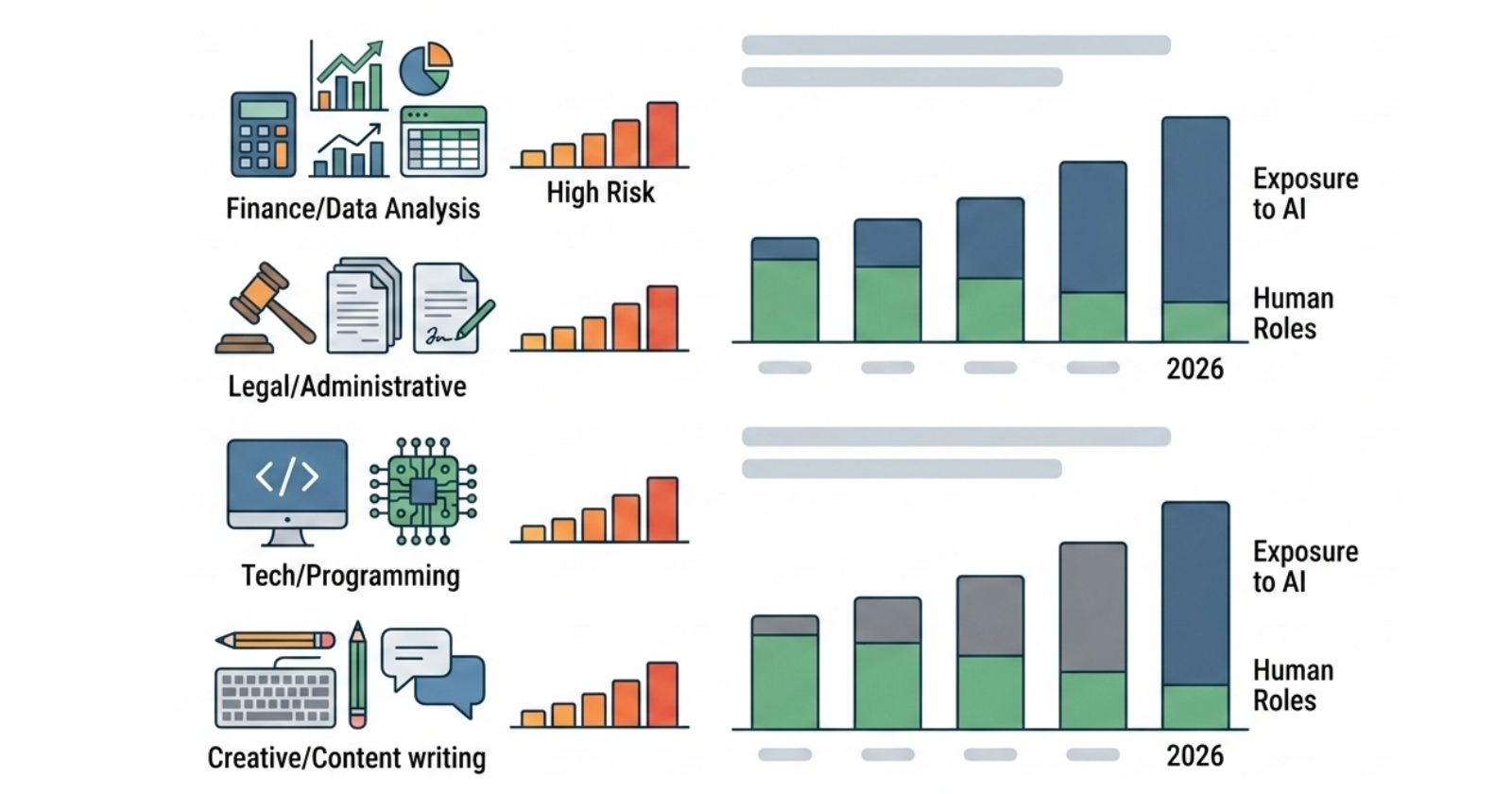
Artificial intelligence has quietly infiltrated the foundations of the American economy, capable of performing tasks that sustain nearly 12 percent of the nation’s jobs. This revelation emerges from a comprehensive study by researchers at the Massachusetts Institute of Technology, highlighting how AI’s cognitive prowess now intersects with roles once considered secure.
As businesses from Wall Street to Main Street harness these tools, the implications ripple through households, communities, and boardrooms alike. The findings underscore a pivotal moment: technology that augments human effort in some areas while threatening to redefine others entirely.
At the heart of this analysis lies the Iceberg Index, a sophisticated simulation tool developed in partnership with Oak Ridge National Laboratory. This metric goes beyond surface-level observations, mapping the overlap between human skills and AI capabilities across more than 151 million workers in 923 occupations spanning 3,000 counties.
What surfaces is a stark picture: AI already possesses the technical and economic feasibility to execute work valued at approximately $1.2 trillion in wages annually. This figure dwarfs the more conspicuous disruptions in technology sectors, which account for just 2.2 percent of wage exposure, or about $211 billion.
The study’s release on November 26, 2025, arrives amid accelerating AI adoption, fueled by advancements in large language models and automation software. Yet, it arrives not as an alarm but as a clarion call for preparation.
Prasanna Balaprakash, director at Oak Ridge National Laboratory and a co-leader of the project, described the index as a “digital twin” of the U.S. labor market—one that simulates interactions between workers and AI agents to forecast ripple effects before they manifest in unemployment lines or hiring freezes.
By treating each worker as an autonomous entity tagged with location, skills, and tasks, the model reveals vulnerabilities that traditional metrics overlook, offering policymakers a granular view down to the zip code level.
Decoding the Iceberg: What the Index Reveals
The Tip Above Water: Visible AI Adoption in Tech
Public attention has fixated on AI’s role in high-profile tech layoffs, where tools like code-generating algorithms have reshaped software development pipelines. Companies now produce over a billion lines of code daily through AI systems, diminishing the need for entry-level programmers and prompting a reevaluation of hiring practices. This “surface index” captures only the most evident changes, concentrated in computing and information technology occupations. According to the MIT report, these shifts represent a mere fraction of the broader exposure, akin to the visible portion of an iceberg.
Recent data from the U.S. Bureau of Labor Statistics reinforces this trend. In the third quarter of 2025, unemployment among 20- to 30-year-olds in AI-exposed tech roles climbed nearly 3 percentage points year-over-year, outpacing gains in less vulnerable sectors. Firms like Amazon have trimmed engineering teams, citing efficiency gains from AI-driven tools, yet overall tech employment remains a slim 5.8 percent of the workforce, per a CompTIA analysis from March 2025. These developments signal early tremors, but the real quake lies beneath.
The Hidden Mass: Broader Sectors at Risk
Delving deeper, the Iceberg Index illuminates AI’s encroachment into white-collar domains long presumed resilient. Finance emerges as a prime example, where AI excels at document processing and routine analytical tasks. Financial services firms deploy these systems to sift through vast datasets, flagging anomalies and generating reports with speed and precision unattainable by human teams alone. The study estimates that up to 40 percent of tasks in financial analysis could shift, not eliminating roles outright but restructuring them toward strategic oversight.
Healthcare follows suit, with AI automating administrative burdens that consume hours of clinicians’ time. Providers now leverage algorithms for scheduling, billing, and even preliminary diagnostics, freeing nurses and doctors to prioritize patient interaction. A 2025 report from the American Hospital Association notes that such implementations have already boosted operational efficiency by 15 percent in pilot programs, though they raise questions about equity in access to upskilled personnel. In professional services, including legal and accounting, AI tools parse contracts and audit ledgers, handling rote elements while humans tackle nuanced judgment calls.
Logistics and manufacturing round out the exposed areas. Operators use AI for fulfillment optimization and quality inspections, reducing errors in supply chains that span the continent. The index quantifies this overlap across 32,000 distinct skills, comparing them against over 13,000 AI applications. Notably, entry-level positions—historically entry points for college graduates—face acute pressure, with nearly 50 million such jobs at risk nationwide, according to National University projections for 2025.
To illustrate the distribution, consider the following table summarizing AI exposure by sector, based on the Iceberg Index and complementary BLS data:
| Sector | Wage Exposure (%) | Estimated Annual Wages ($ Billion) | Key AI Applications |
|---|---|---|---|
| Technology | 2.2 | 211 | Code generation, debugging |
| Finance | 3.5 | 350 | Document processing, risk analysis |
| Healthcare | 2.8 | 280 | Administrative tasks, diagnostics |
| Professional Services | 1.7 | 170 | Contract review, auditing |
| Logistics/Manufacturing | 1.5 | 150 | Quality control, inventory management |
| Total | 11.7 | 1,161 | Cross-sector augmentation |
This breakdown, drawn from MIT’s simulations and cross-referenced with 2025 BLS occupational projections, highlights how AI’s influence permeates beyond Silicon Valley. Rural counties in states like Tennessee and Mississippi show surprising hotspots, where administrative roles in agriculture and energy sectors align closely with AI’s administrative strengths.
Beyond Replacement: Augmentation and Economic Shifts
While headlines evoke fears of mass obsolescence, the MIT researchers emphasize augmentation over outright substitution. In nursing, for instance, AI streamlines paperwork, allowing more bedside time—a net positive for care quality. Similarly, financial analysts may cede routine data crunching to algorithms, pivoting to advisory roles that demand interpersonal acumen. This duality echoes historical tech transitions: the 1978 BBC documentary “Now the Chips Are Down” warned of jobless futures from microprocessors, yet employment for subsequent generations soared as new opportunities emerged.
Empirical evidence supports cautious optimism. A MIT Sloan study spanning 2010 to 2023 found that AI-exposed firms often experienced accelerated revenue and job growth, not contraction. Goldman Sachs Research echoes this, projecting only a 0.5 percentage point unemployment spike during the transition, with 2.5 percent of jobs at displacement risk if adoption scales fully. Still, 30 percent of U.S. workers express anxiety over AI’s encroachment by year’s end, per National University surveys, underscoring the psychological toll of uncertainty.
Vulnerable Demographics: Entry-Level and Regional Disparities
Younger workers bear the brunt. Entry-level hires in tech and finance have dwindled as AI fills foundational gaps, with J.P. Morgan analysis indicating tepid white-collar job growth in AI-heavy subsectors through mid-2025. Geographically, the index challenges coastal-centric narratives: inland states like North Carolina register exposure rates comparable to California when administrative tasks are factored in. Rural areas, often sidelined in AI discourse, face amplified risks due to limited reskilling infrastructure.
Policy Responses: States and Feds Gear Up for the AI Era
State-Level Innovations Leading the Charge
States have seized the Iceberg Index as a blueprint for action. Tennessee pioneered integration into its AI Workforce Action Plan, released in November 2025, allocating funds for simulations that blend AI with physical sectors like manufacturing and nuclear energy. North Carolina Senator DeAndrea Salvador praised the tool’s county-level granularity, using it to model GDP shifts and employment forecasts for census blocks. Utah followed suit, crafting reports that prioritize training in high-exposure zones.
Mississippi’s AI Talent Accelerator Program, launched in 2025 with $9.1 million in grants, exemplifies grassroots momentum, partnering universities to align curricula with practical AI needs. Michigan’s addendum to its statewide workforce plan embeds AI literacy from K-12 onward, while Georgia’s economic development arm funnels resources into tech upskilling hubs.
Federal Backbone: Training and Safety Nets
The White House’s “America’s AI Action Plan,” unveiled in July 2025, commits billions to workforce readiness, directing the Department of Labor to weave AI skills into Workforce Innovation and Opportunity Act programs. This includes guidance for states to leverage youth formula funds for AI certifications and work-based learning. An executive order from April 2025 mandates early AI exposure in education, fostering partnerships with nonprofits and industry for free training resources.
The Department of Labor’s AI Workforce Research Hub, announced in August 2025, tracks real-time impacts, informing agile funding for upskilling. Proposals from Jobs for the Future advocate amending WIOA to establish AI Workforce Centers of Excellence, regional hubs anchored by community colleges to scale training and data integration. These initiatives aim to cultivate “durable human skills”—critical thinking, adaptability—alongside technical prowess, ensuring no worker faces a dead end.
BLS projections for 2023-2033 incorporate AI’s nuances, forecasting growth in resilient fields like aerospace engineering (6 percent) despite productivity boosts. Yet, challenges persist: low adoption rates—under 10 percent economy-wide as of mid-2025—mean impacts remain nascent, buying time but not immunity.
Navigating the Horizon: Opportunities Amid the Overhaul
As AI’s capabilities mature, the U.S. labor market teeters on the cusp of reinvention. The Iceberg Index serves not as a harbinger of doom but a compass for equitable progress, illuminating paths to harness technology for collective gain. Businesses that invest in hybrid human-AI models stand to unlock efficiencies, while workers armed with reskilling stand resilient.
Policymakers must act decisively, channeling resources into inclusive programs that bridge urban-rural divides and generational gaps. Historical precedents—from the microprocessor boom to the internet surge—remind that disruption begets creation. By 2030, AI could automate half of routine tasks globally, yet spawn demand for 20 million new U.S. roles in oversight and innovation, per updated National University estimates.
The true measure of success lies in adaptation: transforming potential peril into prosperity requires vision, investment, and collaboration. As states like Tennessee and federal efforts coalesce, America possesses the tools to steer this revolution toward a future where AI elevates, rather than erodes, the American workforce. The question remains not if change will come, but how swiftly leaders respond to ensure it benefits all.