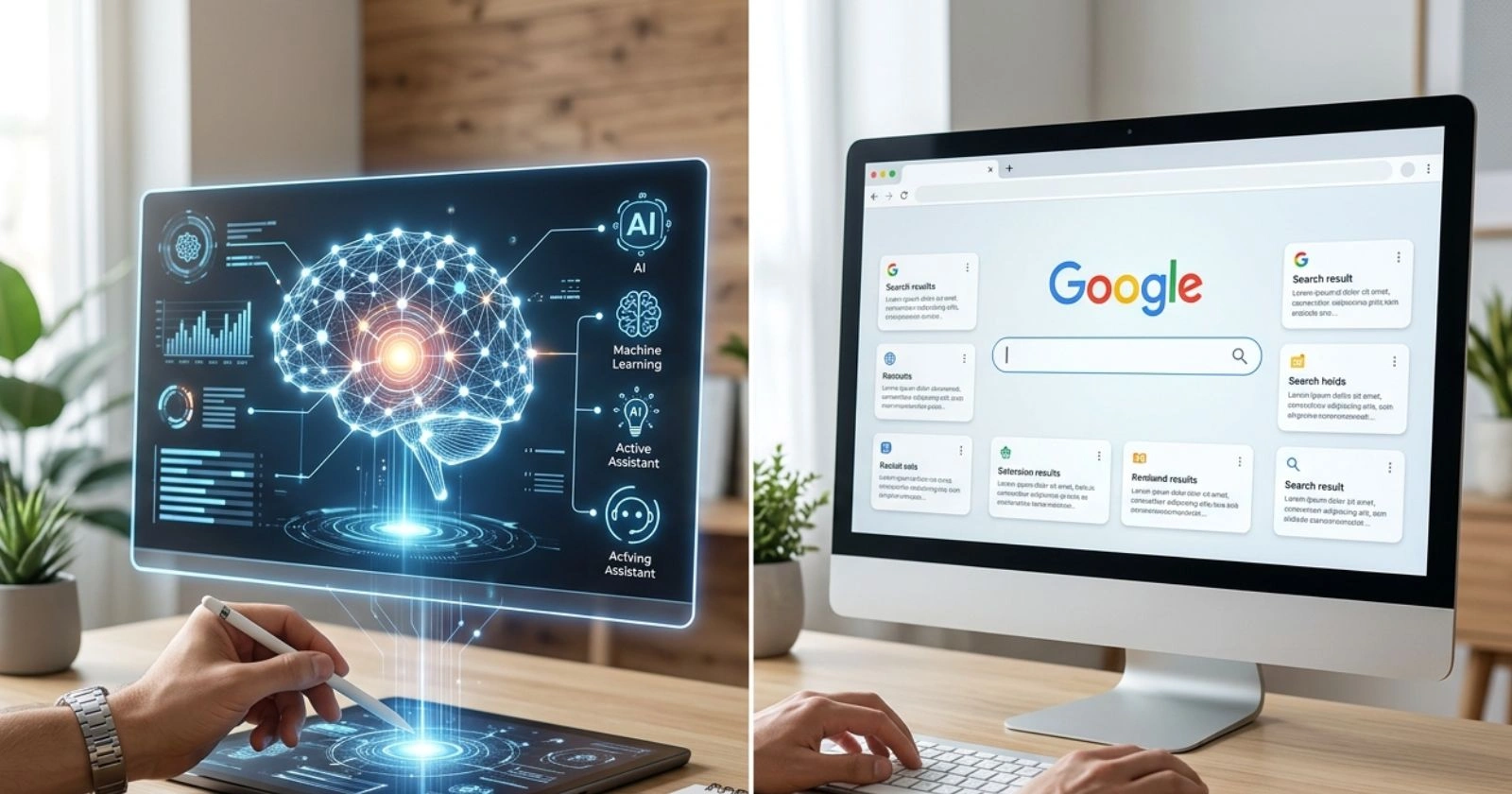
In 2026, the question of whether to type a query into Google or ask an AI has become genuinely complicated. Google processes over 8.5 billion searches per day and has spent decades refining its ability to surface relevant web content. Yet AI chatbots like ChatGPT, Claude, Gemini, and Perplexity have fundamentally changed what people expect from an answer. They do not just point to a source; they synthesize one.
The comparison between AI and Google Search is not simply about which is faster. It is about the nature of the answer itself, who needs it, and for what purpose. The AI vs Google Search debate in 2026 hinges on search intent, information complexity, recency requirements, and the level of trust users can reasonably place in each output.
This guide examines both platforms across key dimensions, clarifies where each excels, and helps readers make informed decisions about when to use which tool.
How Google Search Works vs How AI Answers Work
Understanding the fundamental difference in how these tools operate is essential before comparing their outputs.
Google’s Index and Ranking Model
Google crawls and indexes billions of web pages. When a user submits a query, Google’s algorithm ranks the most relevant pages based on over 200 factors, including authority, freshness, content quality, and user intent signals. The user receives a list of links, along with featured snippets and AI Overviews that summarize content from multiple sources.
Google’s strength is its access to real-time, indexed information. It knows what was published today. It can surface primary sources, official documents, product pages, and local business information with high precision.
How AI Chatbots Generate Responses
AI tools like ChatGPT, Claude, and Gemini generate responses using large language models trained on vast text datasets. These models do not retrieve pre-existing pages; they generate new text based on learned patterns and knowledge. The result feels conversational, synthesized, and complete.
The limitation is the knowledge cutoffs and hallucination risk. AI models may confidently provide outdated or inaccurate information if they lack up-to-date training data or retrieve information poorly. However, tools like Perplexity AI and Google’s Gemini have bridged this gap by combining LLMs with live web retrieval.
Where AI Gives Better Answers Than Google
Complex, Multi-Step Questions
Google search returns pages. AI synthesizes answers. For questions that require pulling together information from multiple sources, AI wins clearly. Asking “What are the tax implications of converting a traditional IRA to a Roth IRA for a high-income earner in California?” produces a nuanced, organized explanation from a good AI model. Google returns links that require the user to read multiple pages and synthesize the answer independently.
Coding and Technical Problem-Solving
AI tools, particularly ChatGPT-4o and Claude 3.7, excel at debugging code, explaining error messages, and generating working solutions to technical problems. Google search returns Stack Overflow threads and documentation pages that require more parsing.
Writing, Editing, and Content Creation
AI is unmatched for drafting, summarizing, and refining written content. Asking Google to “rewrite this paragraph for clarity” produces nothing useful. Asking an AI the same thing produces an immediate, often excellent result. For non-technical writing tasks, AI has no Google equivalent.
Learning New Concepts
When someone wants to understand a complex topic from scratch, such as how neural networks function or how options trading works, AI provides structured, layered explanations tailored to the user’s apparent knowledge level. Google returns articles of varying quality that the user must evaluate independently.
Where Google Search Still Wins
Real-Time and Local Information
For anything time-sensitive, Google is the default. Current news, stock prices, weather, sports scores, local restaurant hours, and recent government announcements require live indexed data. Most AI tools without web access cannot reliably provide this.
Google also dominates local search. Searching “urgent care near me open now” is a task Google handles perfectly. AI without location access and real-time data cannot compete.
Product Research and Shopping
Google’s Shopping results, price comparisons, and review aggregations remain superior for product discovery and purchasing decisions. While AI can summarize product categories, it cannot show live prices, current availability, or real user reviews from the current month.
Navigational Queries
When users want to reach a specific website, Google is faster. Typing a brand name into Google and clicking the first result takes two seconds. Asking an AI for a website URL and then navigating to it takes longer and introduces unnecessary friction.
Academic and Primary Source Research
Google Scholar and Google’s integration with academic databases make it a stronger choice for finding peer-reviewed papers, legal documents, and primary sources. AI can summarize research, but cannot reliably identify the most current or relevant primary sources in a given field.
The distinction between AI capabilities and traditional search has become one of the most discussed topics in the technology space. For those tracking how AI tools are being deployed across industries, the analysis of the most underrated AI applications reveals how AI is filling gaps that traditional search never addressed. The broader shifts in the AI tools market are captured in the AI market growth forecast report, which contextualizes the competitive dynamics between AI search and traditional platforms.
The Hybrid Approach: Tools That Combine Both
Several tools have emerged to combine AI synthesis with live web retrieval, reducing the tradeoffs of choosing one or the other.
Perplexity AI is the leading example. It retrieves real-time web results and then uses an LLM to synthesize a cited, structured answer. Users get AI-quality synthesis with Google-quality recency. Its citation model also addresses the hallucination concern by making sources verifiable.
Google’s Gemini with AI Overviews attempts the same from the other direction. Google’s search results now include AI-generated summaries at the top of results pages, blending its indexed database with Gemini’s language capability.
Bing Chat (Microsoft Copilot) integrates GPT-4 with live Bing search results. It is particularly strong for research-style queries that benefit from both synthesis and freshness.
Those evaluating AI alternatives to Google should review the comprehensive guide to top ChatGPT alternatives and the review of the best AI browsers that integrate AI directly into the browsing experience. The detailed comparison of Claude vs ChatGPT also provides useful benchmarks for those evaluating the leading AI models head-to-head.
Accuracy and Trust: The Critical Difference
Accuracy is where the comparison becomes nuanced. Google does not generate answers; it surfaces sources. The user bears responsibility for evaluating source quality. AI generates answers and presents them confidently, which means its errors feel more authoritative than they are.
Hallucination, the tendency for AI models to generate plausible but false information, remains a genuine concern. In 2025, OpenAI’s GPT-4o was shown to produce factual errors in approximately 3% of responses, according to testing by AI research firm Vectara. This rate decreases for well-documented topics and increases for niche or recent events.
For any high-stakes query, including medical, legal, financial, or technical decisions, verifying AI-generated answers against primary sources remains essential. AI should accelerate research, not replace verification.
When to Use AI and When to Use Google: A Practical Guide
The clearest way to decide is to assess the query type.
Use AI when the task requires synthesis, writing, explanation, code generation, or analysis of information the model was trained on. Use Google when the task requires recency, local information, product prices, primary sources, or navigational queries to specific websites.
For complex research tasks, start with AI for orientation and framework, then use Google to verify specific facts, find primary sources, and check for recent developments.
The Bottom Line for 2026
Neither AI nor Google search is universally superior. They are different tools with different strengths. The most effective users in 2026 move fluidly between both, using AI for synthesis and creation while using Google for discovery and verification.
The gap between the two is narrowing as AI tools incorporate live web access and Google incorporates generative AI. Within two to three years, the distinction between “AI answer” and “search result” may be largely semantic. For now, knowing which tool fits which task is a genuine competitive advantage.
FAQ
Q: Is AI search more accurate than Google Search?
A: Neither is categorically more accurate. Google surfaces existing web pages, so accuracy depends on the sources it ranks. AI generates synthesized answers, which can include hallucinated information. For factual queries, verifying AI answers with primary sources remains important.
Q: Can AI replace Google Search entirely?
A: Not in 2026. AI lacks reliable real-time data access without web retrieval integration. Google remains superior for local search, current events, product shopping, and navigating to specific websites. AI excels at synthesis, explanation, coding, and writing tasks.
Q: What is the best AI alternative to Google Search in 2026?
A: Perplexity AI is the most direct alternative, combining live web retrieval with AI synthesis and source citations. Bing Chat (Microsoft Copilot) is also strong. Both address the recency limitation of pure AI chatbots.
Q: Does Google use AI in its search results?
A: Yes. Google’s AI Overviews feature, powered by Gemini, generates AI-synthesized summaries at the top of many search result pages. Google has integrated AI into its core search experience since 2023, with significant expansion through 2025 and 2026.
Q: Which is better for research, AI or Google?
A: For orienting to a new topic and understanding context, AI is faster. For finding specific studies, primary sources, and current publications, Google Scholar is stronger. Combining both yields the best research workflow.
Q: Are AI answers safe to use for medical or legal questions?
A: AI can provide useful general information on medical and legal topics, but this information should never replace professional advice. AI models can hallucinate on complex or niche questions. Always verify health and legal information with qualified professionals.
Q: Does ChatGPT have access to the internet in 2026?
A: ChatGPT’s GPT-4o model supports web browsing for users on Plus, Team, and Enterprise plans. The free tier may have limited or delayed web access depending on current OpenAI policies.
Q: Is Perplexity AI free to use?
A: Perplexity AI offers a free tier with limited daily Pro searches. The Pro plan, which includes more powerful models and unlimited searches, is priced at $20/month. The free tier is functional for most general queries.
Q: How does Google’s AI Overview compare to Perplexity?
A: Google’s AI Overview is integrated directly into search results and draws from Google’s indexed database. Perplexity is a standalone AI-first experience with stronger synthesis and source citation. Perplexity is generally preferred by researchers; Google AI Overview is more convenient for casual queries.
Q: Will AI eventually make traditional search engines obsolete?
A: This remains debated. Some analysts predict a fundamental shift toward AI-first information retrieval within five years. Others argue that Google’s infrastructure, local data advantages, and advertising model create durable differentiation. The most likely outcome is continued convergence rather than outright replacement.