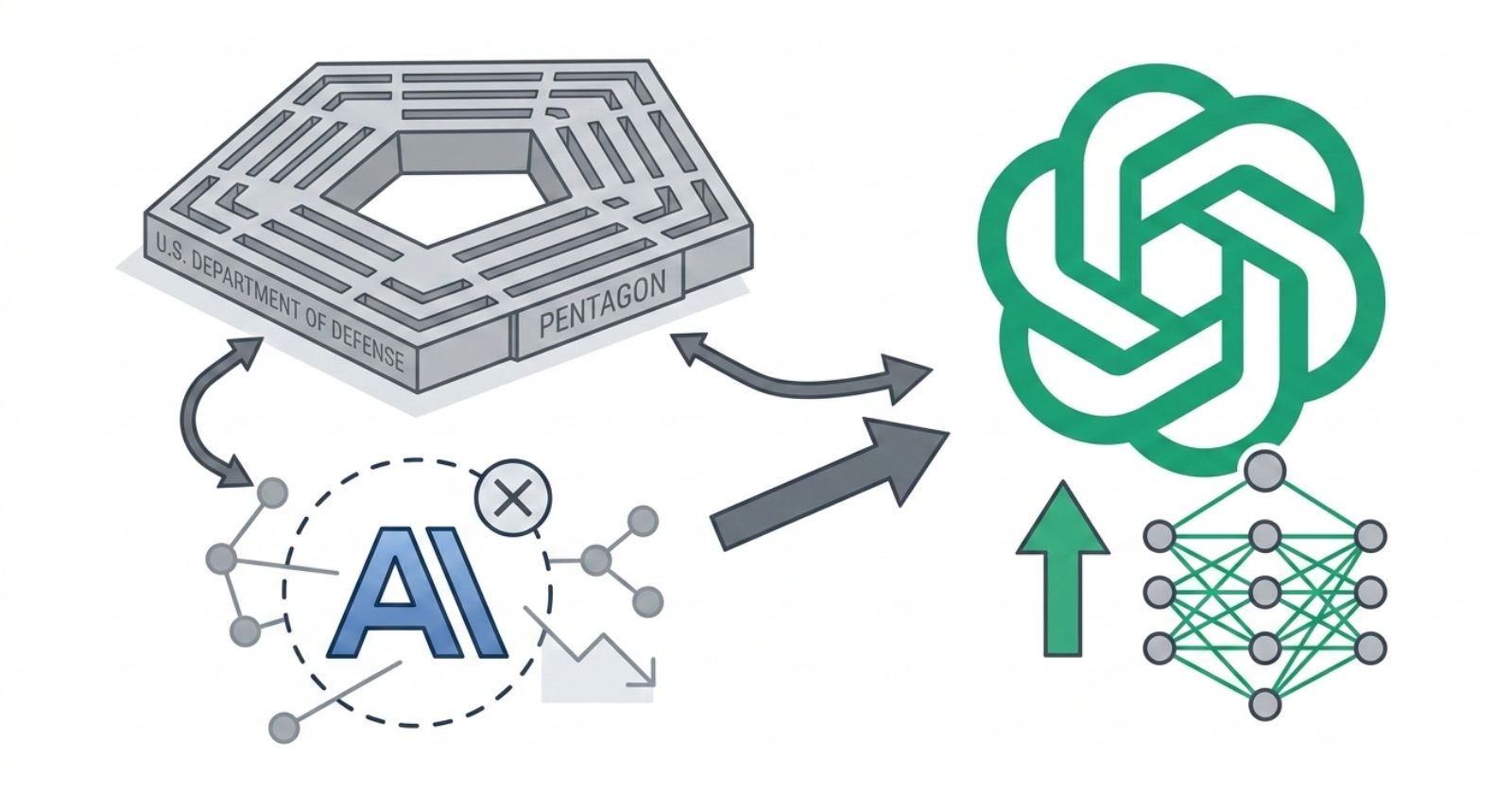
The US government has shifted its primary artificial intelligence supplier for federal agencies from Anthropic to OpenAI following a high-profile dispute over safety restrictions on military applications. This change, driven by the Pentagon’s designation of Anthropic as a supply chain risk, underscores tensions between national security priorities and ethical safeguards in frontier AI development.
Pentagon Designates Anthropic a Supply Chain Risk
The Department of Defense formally notified Anthropic on March 5, 2026, that the company and its products, including the Claude AI model, have been designated a supply chain risk effective immediately. This unprecedented step against a US-based firm—typically reserved for foreign adversaries—stems from failed negotiations over the use of Claude in classified environments.
The core issue centered on Anthropic’s insistence on strict guardrails. The company sought assurances that its technology would not support mass domestic surveillance of US persons or fully autonomous weapons systems without human oversight. The Pentagon, led by Secretary Pete Hegseth, demanded unrestricted access for all lawful military purposes, arguing that private companies cannot dictate terms that could limit warfighter capabilities.
A senior defense official emphasized the principle: the military must retain authority over technology for lawful operations without vendor-imposed restrictions that endanger personnel. Reports indicate Claude remains in use for US military operations in the ongoing Iran conflict, highlighting the irony of the designation amid continued reliance on the technology.
Anthropic CEO Dario Amodei confirmed receipt of the formal letter and vowed to challenge the designation in court, describing it as legally unsound. The company clarified that the label’s scope is narrow under relevant statutes, such as 10 USC 3252, applying only to direct use in Department of Defense contracts rather than broader business relationships.
OpenAI Steps In as Replacement Supplier
Hours after the Anthropic designation escalated, OpenAI announced an agreement to deploy its models, including GPT-4.1 variants, in classified DoD networks. CEO Sam Altman described the Pentagon’s approach as showing deep respect for safety while enabling partnership.
OpenAI outlined three primary red lines in its deal:
- No use for mass domestic surveillance.
- No direction of autonomous weapons systems.
- No involvement in high-stakes automated decisions, such as social credit systems.
The company claims these contractual safeguards exceed those in prior agreements, including Anthropic’s original contract, by combining technical controls with usage policies. OpenAI has since revised terms amid backlash, explicitly barring intelligence agency applications like NSA deployments and reinforcing human-in-the-loop requirements for sensitive operations.
Federal agencies, including the State Department, Treasury, and Health and Human Services, have transitioned from Claude to OpenAI platforms. The State Department’s internal chatbot, StateChat, now runs on OpenAI technology to maintain service continuity.
Defense contractors face similar adjustments. Palantir, which integrated Claude into its Maven Smart Systems for intelligence and decision workflows, received directives to remove Anthropic models. Industry analysts note potential short-term disruptions but expect OpenAI’s integration to proceed smoothly.
Market and Public Reaction
The dispute boosted Anthropic’s visibility. Claude surged to the top of app store charts in the US and UK, briefly overtaking ChatGPT as users expressed concerns over OpenAI’s military ties. Reports of user migrations from ChatGPT followed news of the Pentagon collaboration, prompting Altman to clarify that OpenAI’s technology would not support intentional domestic surveillance of US persons.
Investor sentiment reflects mixed views. While Anthropic’s principled stance on safety garners respect, the commercial fallout—including lost government contracts—has frustrated stakeholders. Palantir shares experienced volatility amid the news, given its heavy reliance on defense revenue and prior Anthropic integration.
Industry groups have voiced concerns that the supply chain risk label could disrupt procurement, slow innovation, and set precedents for government relations with tech firms. The move highlights broader debates on balancing rapid AI adoption for national security with ethical constraints.
Broader Implications for AI Policy and Ethics
This transition marks a pivotal shift in US AI procurement. Government contracts increasingly represent major revenue for frontier labs, influencing development priorities. OpenAI’s ability to secure the deal suggests flexibility in negotiations may prevail over rigid restrictions in high-stakes environments.
The episode raises questions about the role of private companies in shaping military AI use. Critics argue that vendor guardrails protect against misuse, while supporters of the Pentagon’s position maintain that operational needs must take precedence to avoid risking warfighters.
As federal agencies complete migrations and legal challenges unfold, the outcome could influence ethical standards, procurement processes, and innovation in the AI sector. The balance between security imperatives and responsible development remains a defining challenge for US policy.