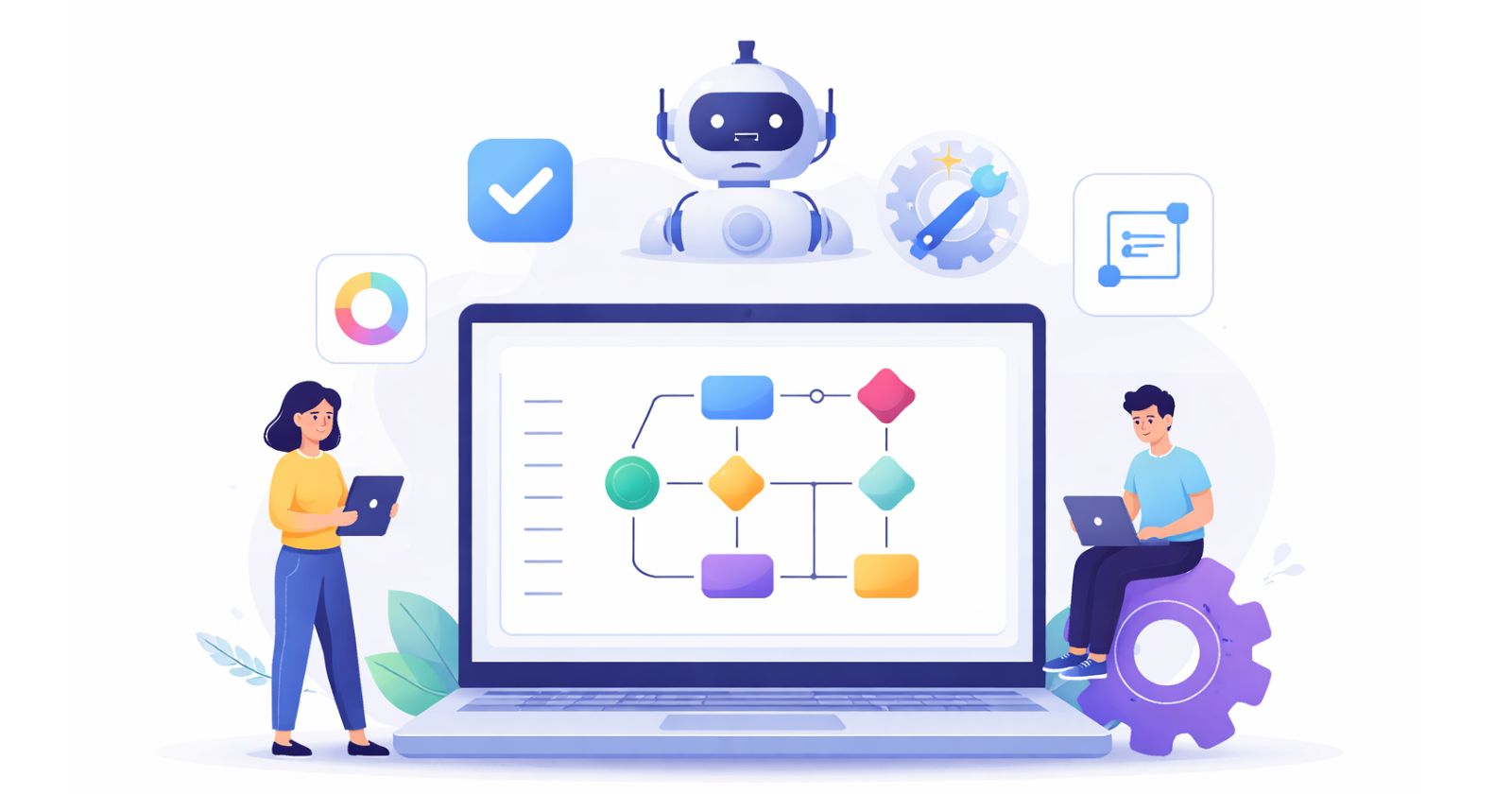
The shift started quietly in late 2023. Small teams discovered they could train AI agents to handle customer support, generate reports, and even close sales deals, all through simple drag-and-drop interfaces.
By mid-2025, Gartner reports that 70% of new business applications are built on no-code platforms, with AI workflow automation leading the charge.
Companies no longer need months of development cycles. A marketing manager can now build an agent that monitors ad performance across Google, Meta, and TikTok, adjusts budgets in real time, and sends Slack alerts when ROI drops below target. This happens without touching a single line of Python or JavaScript.
The real power lies in how these platforms combine large language models with traditional automation logic. Users create workflows using natural language prompts while connecting hundreds of pre-built integrations.
What Exactly Is No-Code AI Workflow Automation?
At its core, this technology lets non-technical users build sophisticated AI-powered processes. Think Zapier on steroids, but with built-in reasoning capability.
Traditional no-code tools like Zapier or Make excel at simple if-this-then-that rules. Modern AI platforms go far beyond. They understand context, make decisions, handle exceptions, and learn from outcomes.
Example: An e-commerce company uses one platform to create an agent that reads new customer reviews, detects sentiment, routes negative ones to the right team member with suggested responses, updates CRM records, and triggers a discount code, all autonomously.
Top Platforms Dominating 2026
n8n with Built-in AI Nodes
The open-source favorite evolved dramatically. The 2025 version includes native AI decision nodes that let users add GPT-4o or Claude 3.5 directly into workflows. Companies love the self-hosting option for data privacy.
Make.com’s AI Agents
Formerly Integromat, Make now offers “AI Agents” that can execute multi-step plans. Users describe goals in plain English (“qualify leads from Typeform and book meetings”), and the platform builds the entire workflow.
Relay.app
Designed for humans first. Relay combines AI agents with human-in-the-loop approvals. Perfect for finance and legal teams needing audit trails.
Lindy.ai
The dark horse is taking over sales teams. Lindy creates personalized AI sales assistants that handle inbound leads, write custom emails based on prospect behavior, and update HubSpot automatically.
Bardeen
The browser-based powerhouse. Bardeen’s “Playbooks” now include autonomous agents that run in the background across all your web apps.
Dust.tt
Enterprise-focused with custom AI assistants trained on company data. Used heavily by consulting firms and law practices.
Real-World Impact: Numbers That Matter
McKinsey’s 2025 automation report shows that companies using no-code AI workflow platforms achieve:
- 85% reduction in repetitive manual tasks
- 60% faster process execution
- 40% lower operational costs
- 3.2x higher employee satisfaction
A Fortune 100 retailer shared that one AI agent built on Make.com now handles what used to require eleven full-time employees in their entire returns processing workflow, runs autonomously with 99.7% accuracy.
How These Platforms Actually Work
The Three-Layer Architecture
- Integration Layer: Connects to 1000+ apps via APIs
- AI Reasoning Layer: Uses LLMs to understand intent and make decisions
- Execution Layer: Performs actions across tools with proper error handling
Building Your First AI Agent
- Step one: Define the goal in natural language
- Step two: Map out trigger events (new email, form submission, etc.)
- Step three: Add decision nodes using prompts
- Step four: Include human approval steps when needed
- Step five: Test and deploy
Most platforms now include “agent templates” for common use cases like lead qualification, content distribution, or meeting scheduling.
Key Features That Separate Winners from Hype
Autonomous Decision Making
Top platforms let agents choose between multiple paths based on data, not just simple if-then rules.
Memory and Learning
Advanced tools remember past interactions and improve responses over time.
Multi-Agent Orchestration
Leading platforms support teams of specialized agents working together. One handles research, another writes content, a third distributes across channels.
Error Recovery
Smart agents detect when something went wrong and either fix it or alert the right person with context.
Industry-Specific Transformations
Sales Teams
AI agents now handle 80% of outbound sequencing. They research prospects on LinkedIn, find emails, write personalized messages based on recent company news, and only involve humans for final calls.
Marketing Departments
Content calendars run themselves. Agents monitor trending topics, generate briefs, create drafts in brand voice, and publish across platforms at optimal times.
Customer Support
Tier-1 support is largely gone. AI agents resolve 70% of tickets instantly while learning from every interaction.
Human Resources
Onboarding workflows that used to take weeks now complete in hours. Agents send paperwork, schedule training, order equipment, and introduce new hires to team members.
Comparison Table: Top 5 Platforms 2026
| Platform | Best For | Pricing Starts | Self-Hosting | Multi-Agent Support | Human-in-Loop |
|---|---|---|---|---|---|
| n8n | Technical teams | Free | Yes | Advanced | Yes |
| Make.com | Marketing & Operations | $9/month | No | Strong | Yes |
| Lindy.ai | Sales teams | $49/month | No | Growing | Yes |
| Bardeen | Individual power users | Free | Extension | Basic | Limited |
| Dust.tt | Enterprise with compliance | Custom | Yes | Advanced | Strong |
Security and Compliance Considerations
Leading platforms now offer SOC 2 Type II, GDPR, and HIPAA compliance. Many provide private cloud deployment options. Data never trains public models without explicit permission.
Future Outlook: Where This Goes Next
Analysts predict that by 2027, 90% of business processes will include AI agents built by non-technical employees. The next wave includes:
- Voice-first agent creation
- Predictive workflow suggestions
- Cross-company agent collaboration
- Built-in ROI tracking
Getting Started Today
Most platforms offer free tiers generous enough to build sophisticated agents. The learning curve has flattened dramatically; many users create their first working agent in under an hour.
The companies winning in 2026 share one trait: they stopped waiting for IT backlogs and started building solutions themselves. Marketing built its own lead scoring. Operations automated vendor payments. Support teams created personalized follow-up sequences.
This shift represents the largest transfer of technical capability to business users in history. The tools have matured, the models have become reliable, and the results speak for themselves.
Those who embrace no-code AI workflow automation today position themselves years ahead of competitors still waiting for development resources. The future of work is already here; it just requires a browser and the willingness to experiment.
The era of waiting months for simple automations has ended. Today, anyone can build intelligent systems that think, decide, and execute across their entire tech stack. The only remaining question is who will move first.
10 Most Asked Questions
Can no-code AI really replace developers?
Not entirely, but it eliminates 80-90% of routine integration and automation work.
How accurate are these AI agents?
Top platforms achieve 95-99% accuracy on structured tasks after initial training.
Do I lose control when using AI agents?
No. Every platform includes monitoring dashboards and human approval steps.
What happens when the AI makes a mistake?
Agents either self-correct using built-in rules or pause and notify humans with full context.
Are these platforms secure for sensitive data?
Leading tools offer enterprise-grade encryption and compliance certifications.
How long does it take to build a complex workflow?
Most users build sophisticated agents in 2-10 hours, compared to weeks with traditional development.
Can multiple agents work together?
Yes. Advanced platforms support the orchestration of specialized agents.
Do I need to know prompt engineering?
Basic understanding helps, but modern platforms include pre-tested prompts.
What’s the ROI timeline?
Most companies see positive ROI within the first month.
Will this technology eliminate jobs?
It eliminates repetitive tasks while creating demand for higher-value strategic work.