A groundbreaking new study reveals that generative artificial intelligence could substantially narrow wage inequality across the labor market while lifting average wages by 21 percent. This optimistic projection emerges from advanced economic modeling that highlights AI’s unique ability to democratize access to high-value tasks, challenging long-held assumptions about technology’s role in widening economic divides.
Stanford Researchers Introduce New Model for AI’s Labor Market Effects
Economists Lukas Althoff, an assistant professor at Stanford University, and Hugo Reichardt, an affiliated professor at the Barcelona School of Economics, published their working paper titled “Task-Specific Technical Change and Comparative Advantage” in late 2025 (most recent version November 26, 2025). (Source: https://hugoreichardt.github.io/pdf/tstc_compadvantage.pdf).
The authors developed a dynamic task-based model that accounts for how workers build multidimensional skills over time, influencing their comparative advantage and occupational choices. This framework examines generative AI’s effects through three channels:
- Augmentation: Enhancing human productivity on existing tasks.
- Automation: Replacing human labor in certain activities.
- Simplification: A novel channel where AI reduces the skill requirements needed to perform complex tasks effectively.
The study’s core conclusion centers on simplification as the dominant force. By lowering skill-based barriers, generative AI enables lower-skilled workers to handle tasks and enter occupations that previously required advanced expertise. This shift boosts the relative productivity of lower-skill workers, allowing them to compete more directly with higher-skilled colleagues.
Key Findings on Wages and Inequality Reduction
The quantified model predicts that widespread adoption of generative AI raises average wages by 21 percent while substantially reducing wage inequality. This equalizing impact stems entirely from the simplification effect, which erodes traditional skill hierarchies.
Additional benefits include sizable welfare gains for most workers entering the labor market. The researchers estimate these improvements equate to permanent wage increases of 26 to 34 percent for nearly all individuals at the start of their careers.
These projections align with emerging labor market data, suggesting early signs of AI’s transformative influence are already visible.
White House AI and cryptocurrency czar David Sacks described the findings as a “narrative violation” on X, underscoring how the results challenge conventional views that technology inevitably exacerbates inequality.
(Source: Fox Business, January 17, 2026; IndexBox blog summarizing the study, January 17, 2026)
Occupational Shifts and Employment Reallocation
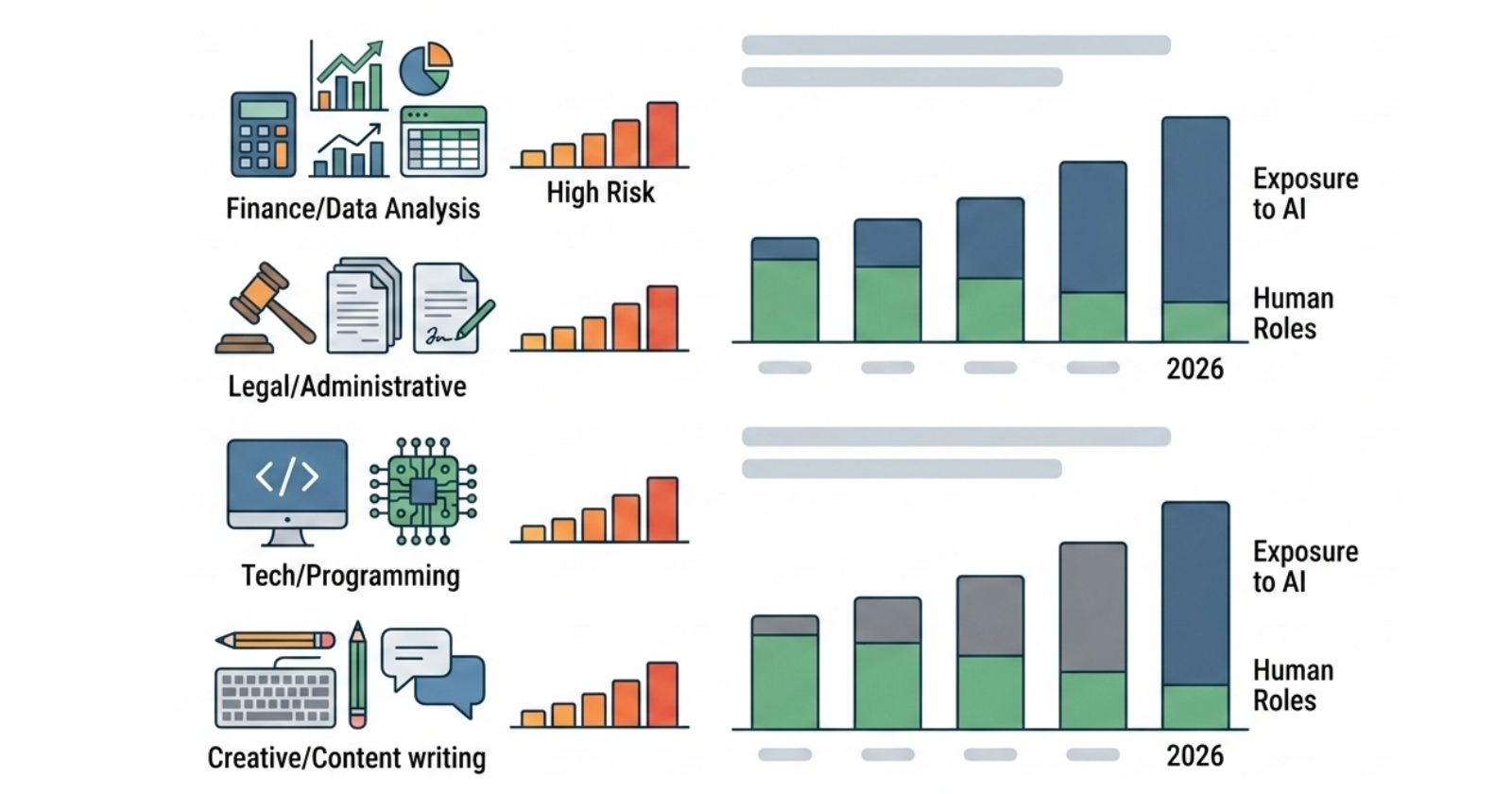
Generative AI drives a significant reallocation of employment across occupations. Administrative roles, such as financial clerks, face substantial declines in demand as routine tasks become easier to handle with simplified tools.
In contrast, science-related occupations, including life scientists, experience expansion. These shifts reflect AI’s capacity to automate repetitive administrative work while augmenting discovery and innovation in technical fields.
On average, wages increase across the board, but certain high-skill professions see absolute declines. For instance, architects, engineers, and executives may experience downward pressure on pay. Notably, occupations with the largest employment gains often show the sharpest relative wage decreases, as more workers gain access to those roles.
This reallocation pattern echoes broader trends observed in recent analyses, though some studies highlight short-term disruptions. For example, payroll data research from Stanford’s Digital Economy Lab indicates potential early employment declines for younger workers in AI-exposed fields, suggesting adjustment frictions during transition periods.
Broader Context from Other Research
While the Althoff and Reichardt paper offers a forward-looking, general-equilibrium perspective, complementary studies provide nuanced insights. An IMF working paper from 2025 explores how AI adoption could reduce wage inequality by displacing higher-income workers in certain scenarios, though wealth effects from capital returns might offset some gains.
OECD analysis from 2024 and updated reports indicate that AI exposure correlates with slower increases or even declines in within-occupation wage inequality in many countries.
PwC’s 2025 Global AI Jobs Barometer points to real-world wage boosts in AI-adopting firms, particularly where productivity surges benefit a wide range of roles.
These findings collectively suggest that generative AI’s net effect may lean toward compression of wage disparities, especially if simplification prevails over pure automation.
Implications for Workers and Policy
The potential for generative AI to level the playing field carries profound implications. Lower-skilled workers stand to gain the most from reduced barriers to entry in skilled occupations, potentially accelerating upward mobility.
However, successful adaptation requires workers to acquire new skills and shift occupations. Employers face incentives to invest in AI tools that augment rather than replace human capabilities.
Policymakers must prepare for transitional challenges, including reallocation frictions and the need for reskilling programs. Education systems and training initiatives should emphasize lifelong learning to help individuals navigate evolving job landscapes.
The study’s emphasis on simplification offers hope that generative AI differs from past technologies, which often amplified skill-biased effects and widened gaps. Instead, this wave of innovation could foster greater inclusivity in economic rewards.
As adoption accelerates, ongoing monitoring of real-world outcomes will determine whether these modeled benefits fully materialize. The labor market stands at a pivotal juncture, where artificial intelligence holds the promise of broader prosperity rather than deepened division.