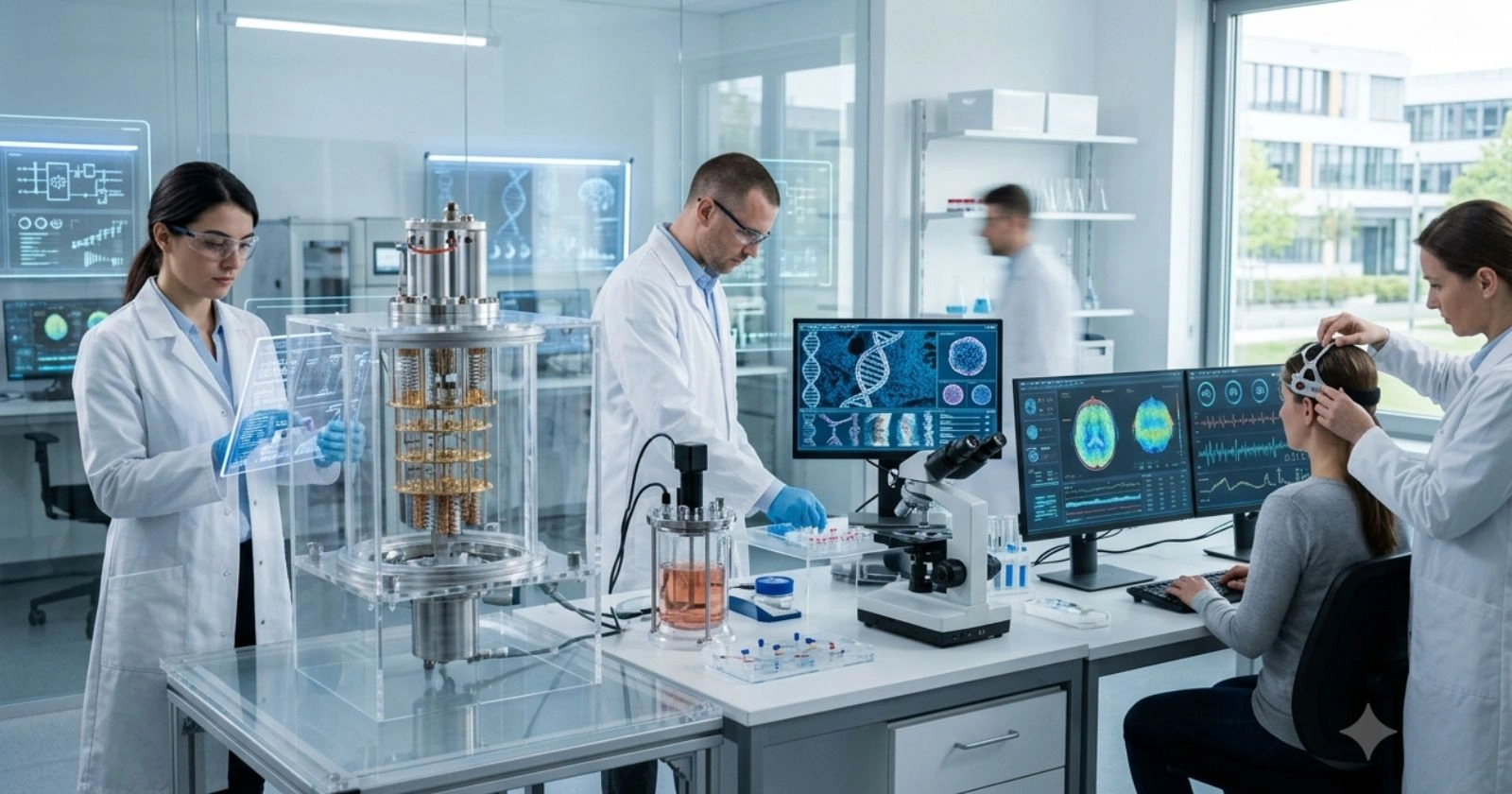
Artificial intelligence stunned the world between 2020 and 2025. Models went from writing decent essays to passing bar exams, generating Hollywood-level video, and discovering new drugs. Yet the low-hanging fruit is almost gone. Training costs now run into billions, energy demands rival small countries, and performance gains shrink with every new model release.
Researchers at Epoch AI and OpenAI itself project that frontier labs could hit practical limits on compute and data as early as 2027 if current trends hold. Scaling laws still work, but the price tag grows exponentially while real-world usefulness plateaus. The age of “just add more GPUs” is ending.
That reality forces a simple question: what comes next?
Quantum Computing Leaves the Lab
Quantum machines have graduated from science fair curiosities to delivering actual business value. In May 2025, Google published results showing its Willow chip solved a meaningful materials-science problem in under five minutes that would take the world’s fastest supercomputer 10 septillion years. IBM now runs a 1,121-qubit system available to Fortune 500 companies through the cloud.
Useful quantum advantage already exists in narrow domains: drug discovery, battery chemistry, and financial risk modeling. McKinsey estimates the technology could create $1 trillion in annual economic value by 2035, with most gains arriving between 2028 and 2032.
Companies like PsiQuantum and IonQ plan utility-scale, fault-tolerant systems with millions of logical qubits before 2030. When those machines arrive, entire classes of problems in logistics, cryptography, and climate modeling become trivial overnight.
Programmable Biology Becomes Reality
Synthetic biology has quietly turned living cells into programmable factories. Scientists now write DNA the way coders write Python. Ginkgo Bioworks designs custom organisms for clients the same way software teams build apps. In 2024, researchers at Stanford created the first fully synthetic yeast chromosome that works inside a living cell.
The implications stretch far beyond glowing plants. Engineered microbes already produce insulin, spider silk, and meat without animals. By 2027, several companies expect FDA approval for living therapeutics: bacteria that live in your gut and release drugs exactly when needed.
The global bioeconomy already exceeds $4 trillion, according to the World Economic Forum, and grows faster than Moore’s Law ever did. Biology is becoming an information technology, and the read-write era has begun.
Key Milestones Already Achieved
- 2023: First complete synthetic bacterium capable of self-replication
- 2024: Lab-grown meat receives full USDA approval and hits grocery shelves
- 2025: Living cancer therapies enter phase 3 trials with 90% response rates in specific leukemias
Brain-Computer Interfaces Go Mainstream
Neuralink implanted its first human patient in 2024. By mid-2025, the company reports over 1,000 patients worldwide, most restoring vision or movement after spinal injuries. Competitors Synchron, Paradromics, and Blackrock Neurotech report similar progress.
Bandwidth keeps doubling every year. Early implants offered a few dozen channels; the newest generation exceeds 10,000. Patients now browse the internet, play video games, and even control robotic arms with thought alone.
The leap from medical device to consumer product feels closer than anyone predicted. Elon Musk stated publicly that non-medical implants could begin human trials as early as 2027, pending regulatory approval.
Energy Abundance Changes Everything
Fusion research crossed major thresholds in 2025. Helion Energy signed its first commercial power purchase agreement with Microsoft for delivery starting in 2028. Commonwealth Fusion Systems expects a net-positive demonstration in 2026, with pilot plants online by 2030.
When energy becomes too cheap to meter, entire industries transform. Desalination solves water scarcity. Direct air capture reverses climate change at scale. Vertical farms in deserts feed billions.
Cheap energy also supercharges every other trend on this list. Quantum computers need cryogenic cooling. Biomanufacturing runs massive fermenters. Data centers for the next generation of intelligence demand power that only fusion or advanced fission can supply.
The Convergence Point
These fields do not advance in isolation. They feed one another.
Quantum algorithms speed genomic design. Synthetic biology creates new materials for better qubits. Brain interfaces let humans stay in the loop as machines grow superintelligent. Fusion provides the energy to run it all.
Goldman Sachs calls this the “GPB Era”: General Purpose Biology joining General Purpose Computing and, soon, General Purpose Physics through quantum mechanics.
Jobs and Society Face Another Shock
The 2020s showed how fast labor markets can shift. White-collar knowledge work automated faster than anyone predicted. The 2030s will hit different sectors.
Synthetic biology threatens traditional agriculture, pharmaceuticals, and chemicals. Quantum optimization disrupts logistics, finance, and supply chains. Brain interfaces create entirely new categories of work while eliminating others.
Yet history suggests adaptation, not collapse. The internet destroyed some jobs and created millions more that did not exist in 1995. Society has roughly one decade to prepare education, policy, and culture for the next leap.
Investment Flows Tell the Story
Venture capital data reveals where smart money now moves. In 2023, AI captured 48% of all US venture dollars. By Q3 2025, that share dropped below 25%. Quantum startups raised $3.2 billion in the first half of 2025 alone. Biotech funds focused on platform companies (those building the tools to program life) hit record inflows.
ARK Invest shifted its flagship innovation ETF to an overweight fusion, quantum, and neurotechnology starting in 2025. Cathie Wood calls the coming decade “the biggest wealth creation event in history.”
Timeline of the Next Decade
| Year | Milestone | Primary Impact |
|---|---|---|
| 2026 | First million-qubit fault-tolerant quantum system | Cryptography breaks, new materials discovered |
| 2027 | Consumer brain interfaces enter clinical trials | Augmentation market begins |
| 2028 | Commercial fusion power online (Helion) | Energy prices collapse |
| 2029 | Fully programmable multicellular organisms | Agriculture and medicine transformed |
| 2030 | Quantum advantage in logistics and finance | Global supply chains re-optimized |
| 2032 | Brain-cloud interfaces with millions of users | Redefines human-machine relationship |
Ethical and Governance Challenges Loom Large
Progress rarely arrives cleanly. Brain interfaces raise questions of privacy when thoughts become readable. Programmable biology creates risks of accidental or intentional harm. Quantum computing ends current encryption overnight.
Nations already race to lead. The United States, China, and the European Union each poured tens of billions into quantum and biotech in their 2025 budgets. International frameworks lag years behind the science.
Responsible development matters more than ever. The technologies themselves remain neutral; outcomes depend on choices made today.
The Human Opportunity
Every technological shift brings fear and promise in equal measure. Electricity terrified people before it lit the world. The same pattern repeats.
The next decade offers a rare chance to solve grand challenges: climate change, disease, poverty, and even the limits of mortality. Biology and physics now move at the speed of software.
Those who understand the shift early will shape it. Students choosing majors today pick between yesterday’s boom and tomorrow’s foundation. Investors allocating capital decide which future gets built. Policymakers writing rules determine whether progress serves billions or concentrates in a few hands.
The AI era was just the warm-up. The real transformation starts now.
FAQs
Will quantum computing replace AI completely?
No. Quantum excels at specific problems like simulation and optimization, while AI remains superior for pattern recognition and language. Most experts expect hybrid systems.
When will brain-computer interfaces become available to healthy people?
Medical versions already help patients. Consumer versions for enhancement could reach the market between 2028 and 2032, depending on regulatory approval.
Is synthetic biology safe?
Risks exist, just as they did with genetic engineering decades ago. Modern platforms include built-in kill switches and strict containment. Oversight continues to evolve.
Which jobs are most at risk in the next wave?
Traditional chemistry, materials science, logistics planning, and some medical diagnostics face disruption first. Creative, hands-on, and human-centered roles remain harder to automate.
Can fusion really deliver unlimited clean energy by 2030?
Multiple private companies target commercial plants before 2030. Even if timelines slip a few years, the physics now works. The question is engineering and scaling.
How much faster is quantum computing than classical?
For specific problems, the speedup can be billions or trillions of times. For general tasks like web browsing, quantum offers no advantage.
Will we see designer babies soon?
Basic trait selection already happens through embryo screening. Full genetic design faces technical hurdles and ethical barriers that will delay widespread use for decades.
What should students study to stay relevant?
Quantum information science, synthetic biology, neuroscience, and energy systems top the list. Strong foundations in physics, biology, and computer science provide the most flexibility.
Are we prepared for quantum breaking of current encryption?
Major organizations began migrating to post-quantum cryptography in 2024. Full transition will take years, creating a window of vulnerability from 2028 to 2032.
Which technology will have the biggest impact by 2040?
Most analysts rank programmable biology highest because it touches food, medicine, materials, and energy simultaneously. Brain interfaces could rival it if bandwidth continues doubling annually.