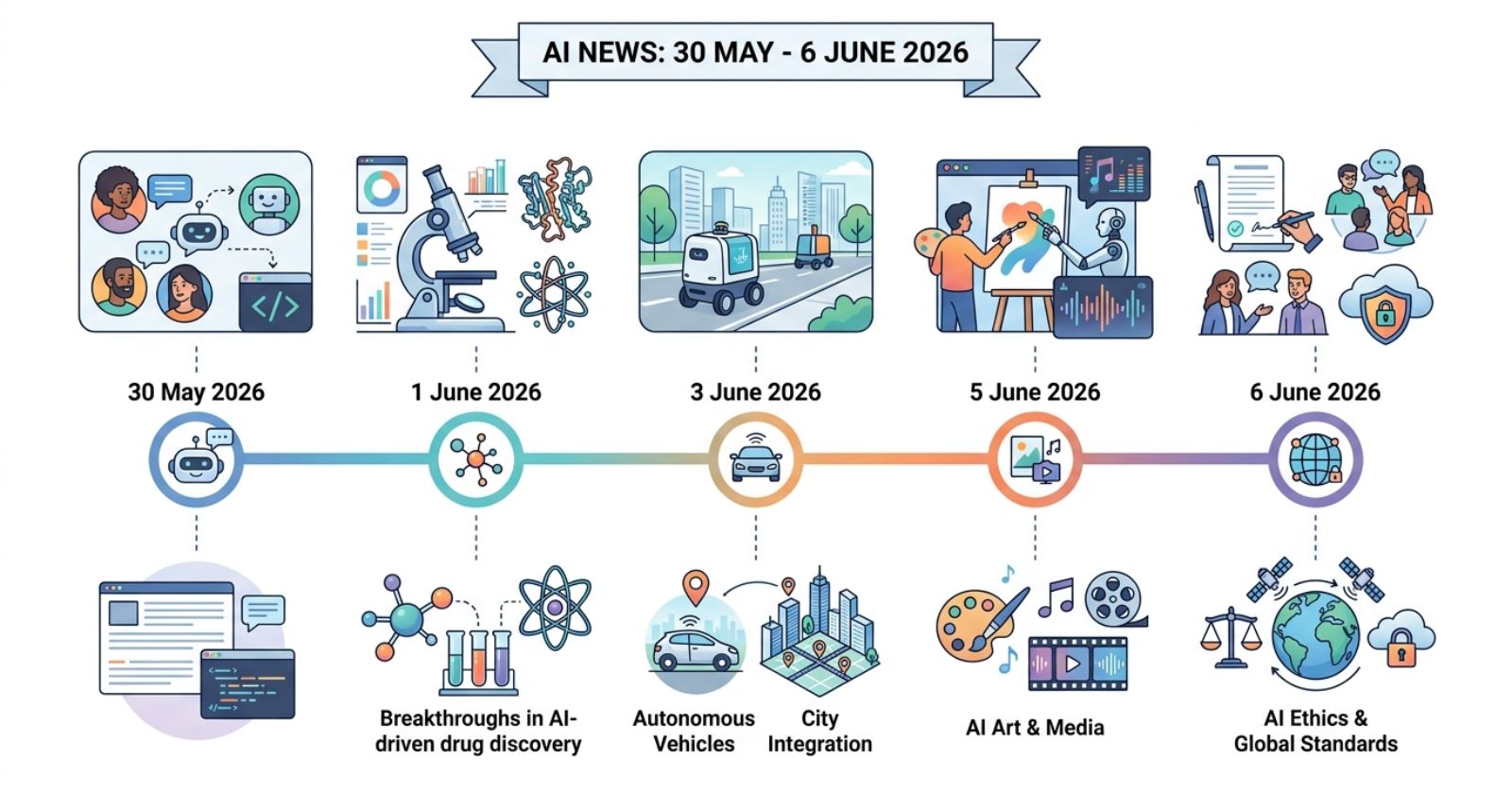
The AI news from 30th May to 6th June 2026 compressed a year of strategic shifts into seven days. Anthropic filed confidentially for one of the largest technology IPOs ever attempted, Microsoft declared independence from its OpenAI dependency with seven homegrown models, and President Trump signed an executive order that reshapes how frontier systems reach the public.
Below are the most significant verified stories from the week, each with the figures, sources, and competitive context that explain why they matter.
Key headlines this week:
- Anthropic confidentially filed a draft S-1 with the SEC, days after a $65 billion round valued it at $965 billion.
- NVIDIA named Anthropic, OpenAI, SpaceX, and Oracle as the first users of its Vera CPU.
- Microsoft launched seven in-house MAI models at Build 2026, including MAI-Thinking-1 and MAI-Code-1.
- GitHub Copilot moved every plan to usage-based AI Credits billing.
- MiniMax released M3, the first open-weight model to combine frontier coding, a 1M-token context, and native multimodality.
- Meta launched Meta Business Agent across WhatsApp, Messenger, and Instagram.
- OpenAI expanded its Rosalind Biodefense program and trusted access to GPT-Rosalind.
- President Trump signed an executive order setting voluntary pre-release reviews for frontier AI.
- A bipartisan House draft, the Great American AI Act, proposed preempting state AI laws for three years.
- AlphaSense raised $350 million at a $7.5 billion valuation.
- Anthropic expanded Project Glasswing and Claude Mythos access to roughly 150 critical infrastructure organizations.
Anthropic Files Confidentially for a Potential Trillion-Dollar IPO
Anthropic told the market on June 1 that it had confidentially submitted a draft registration statement on Form S-1 to the US Securities and Exchange Commission. The filing sets up one of the most-watched public debuts in technology history. The company stated that the timing and pricing remain undecided and will depend on market conditions.
The move carries weight because of the numbers behind it. The filing landed less than a week after Anthropic closed a $65 billion Series H round that lifted its valuation to roughly $965 billion. That figure surpassed OpenAI’s last private valuation of $852 billion, marking the first time Anthropic has topped its rival in the private market. Its annualized revenue run rate reached about $47 billion in May 2026, up from nearly $10 billion a year earlier.
The strategic read is sharp. By filing ahead of OpenAI and SpaceX, Anthropic positions itself to define investor expectations for the entire 2026 AI listing cycle. A confidential draft lets the company refine disclosures with regulators before any prospectus goes public, which gives it control over the narrative. The bigger question for buyers is whether a roughly $1 trillion debut reflects durable enterprise demand or the peak of an AI funding cycle that critics warn is outpacing real revenue.
Source: Anthropic | https://www.anthropic.com/news/confidential-draft-s1-sec
NVIDIA Names Anthropic, OpenAI, and SpaceX as First Vera Chip Users
NVIDIA used its momentum at Computex in Taipei to confirm that Anthropic, OpenAI, SpaceX, and Oracle are the first major users of Vera, its new in-house CPU. The company’s own blog detailed how engineering leader Ian Buck hand-delivered the first Vera systems to the labs in late May before the wider reveal. Full production is set for the third quarter of 2026.
Vera is a notable departure for a company built on graphics chips. It is built around 88 of NVIDIA’s own Olympus cores rather than off-the-shelf Arm Neoverse cores, and the company frames it as a ground-up redesign of its previous Grace processor. NVIDIA pairs Vera with its Rubin GPU to form the Vera Rubin platform, a single-vendor stack for both model training and agentic inference. Early reporting puts Vera’s performance at roughly 1.8 times faster than competing Intel and AMD parts for agent workloads.
The competitive signal is clear. By designing a CPU purpose-built for agents that plan and act rather than simply answer prompts, NVIDIA is extending its grip beyond GPUs into the full data center stack. Securing the four marquee customers before mass production locks in demand and pressures rival cloud providers to chase the same footprint. For Anthropic and OpenAI, it also deepens a dependency on NVIDIA at the exact moment both are scaling compute for ever-larger agentic systems.
Source: NVIDIA | https://blogs.nvidia.com/blog/vera-cpu-delivery/
Microsoft Launches Seven MAI Models at Build 2026
At Build 2026 in San Francisco on June 2, Microsoft unveiled a family of seven in-house models branded MAI. The headline release is MAI-Thinking-1, the company’s first dedicated reasoning model. It is a mid-sized, sparse Mixture of Experts model with 35 billion active parameters and a 256,000-token context window, trained on commercially licensed data without distillation from any third-party model.
The rollout spans far more than reasoning. MAI-Code-1, an inference-efficient coding model tuned for GitHub, shipped into Copilot and VS Code, while MAI-Image-2.5, MAI-Transcribe-1.5, and MAI-Voice-2 landed across PowerPoint, OneDrive, and Foundry. Microsoft said independent raters preferred MAI-Thinking-1 to Claude Sonnet 4.6 in a blind test, and that it matches Claude Opus 4.6 on SWE-Bench Pro coding tasks. The models will also be available through Fireworks AI, Baseten, and OpenRouter.
The deeper story is independence. For years, Microsoft’s AI story was effectively “we have OpenAI,” and Build 2026 reframes the company as a model maker, runtime owner, and hardware vendor in its own right. Neither MAI-Thinking-1 nor MAI-Code-1 is a frontier leader, yet they signal that the OpenAI-exclusive era of Copilot is over. For developers, the practical effect is more model choice inside familiar tools and downward pressure on per-token coding costs.
Source: Microsoft | https://blogs.microsoft.com/blog/2026/06/02/microsoft-build-2026-be-yourself-at-work/
GitHub Copilot Switches Every Plan to Usage-Based AI Credits
On June 1, GitHub moved all Copilot plans to usage-based billing, replacing premium request units with a token-linked currency called GitHub AI Credits. Each plan now includes a monthly allowance of credits, with the option for paid tiers to buy more. Usage is calculated on token consumption across input, output, and cached tokens, priced per model.
The change reflects the economics of agentic coding. Basic code completions remain unlimited, but heavier features such as Copilot Chat, autonomous coding agents, and code review now draw down a credit balance. GitHub set a temporary flex bonus from June through September to cushion the transition, with the base allowance taking over afterward. Copilot Pro includes $10 in monthly credits, Pro+ includes $39, and code review now also consumes GitHub Actions minutes.
Developer reaction has been pointed. The shift turns a predictable subscription into a metered compute service, and many heavy users warn of sharp cost increases. The underlying message matters beyond pricing: agentic software development now carries cloud-style economics, where long-running autonomous sessions resemble infrastructure usage rather than a flat seat. Enterprises standardizing on AI coding tools will need budget controls and model-routing strategies that did not exist a year ago.
Source: GitHub | https://github.blog/news-insights/company-news/github-copilot-is-moving-to-usage-based-billing/
MiniMax M3 Ships as a Frontier-Class Open-Weight Model
Shanghai-based MiniMax launched its M3 foundation model on June 1, positioning it as the first open-weight system to combine frontier coding, a one-million-token context window, and native multimodality in a single model. The model handles text, image, and video input, and can operate a desktop computer. The API went live immediately, with open weights and a technical report promised within roughly ten days.
The benchmarks drew attention for their price-to-performance ratio. M3 scored 59.0% on SWE-Bench Pro, edging past GPT-5.5 at 58.6% and Gemini 3.1 Pro, while trailing Claude Opus 4.7 and the newer Opus 4.8. Its MiniMax Sparse Attention architecture cuts per-token compute at a one-million-token context to about one-twentieth of the prior generation. Launch pricing sat near $0.30 per million input tokens and $1.20 per million output tokens, a fraction of comparable closed models.
Two caveats temper the hype. The scores are vendor-run rather than independently verified, and the weights had not shipped at launch. Even so, M3 narrows the gap between open and closed systems to its thinnest point yet, which pressures margins for proprietary coding APIs. For developers seeking data control and self-hosting, an open model that approaches frontier coding at a tenth of the cost changes the build-versus-buy calculation.
Source: TechTimes | https://www.techtimes.com/articles/317532/20260601/minimax-m3-open-weight-coding-model-frontier-claims-unverified-benchmarks.htm
Meta Launches Business Agent to Diversify Beyond Ads
At its Conversations conference in London on June 3, Meta introduced Meta Business Agent, an AI service that helps companies talk to customers across WhatsApp, Messenger, and Instagram. The agent can answer inquiries, recommend products, and book appointments, and it integrates with external systems such as Shopify and Zendesk. It builds on a free test version, then called Business AI, that Meta ran in markets including India and Mexico.
The financial motive is plain. Advertising still accounts for roughly 98% of Meta’s revenue, and Meta Business Agent represents its clearest attempt yet to earn money directly from AI. Large businesses on the WhatsApp Business Platform will pay on a consumption basis, while the tool also feeds the company’s Meta One subscription strategy. Meta shares rose more than 4% as investors weighed the monetization step against the company’s heavy capital spending plans.
The agent puts Meta into direct competition with Amazon, Microsoft, and OpenAI in the enterprise agent market. Chief Executive Mark Zuckerberg framed the long-term vision as agents that eventually help run an entire business, not just reply to messages. The reach is the differentiator: more than 200 million small businesses already use WhatsApp, which gives Meta a built-in distribution channel few rivals can match. The open risk is whether consumption-based business messaging can grow fast enough to matter against a near-trillion-dollar ad engine.
Source: CNBC | https://www.cnbc.com/2026/06/03/meta-business-agent-is-zuckerberg-latest-effort-to-diversify-from-ads.html
OpenAI Expands Rosalind Biodefense and GPT-Rosalind Access
OpenAI broadened its Rosalind Biodefense program and extended trusted access to GPT-Rosalind, its purpose-built life sciences model, in announcements dated May 29 and June 3. The program sponsors access for vetted developers and select US government and allied public-health partners working on early-warning systems, outbreak modeling, diagnostics, and medical countermeasures. Partners include the Coalition for Epidemic Preparedness Innovations and national laboratories.
The technical and policy details are tightly linked. GPT-Rosalind builds on GPT-5.5 with stronger performance on drug research tasks and completes long quantitative-biology analyses using about 31% fewer tokens. OpenAI deploys it through a gated, trusted-access structure precisely because a model that reasons over molecules, genes, and proteins carries dual-use risk. The company worked with the US Center for AI Standards and Innovation, the UK AI Security Institute, and Los Alamos National Laboratory on its evaluation approach.
The expansion confirms that frontier-lab biodefense has become a genuine category, sitting alongside Anthropic’s cybersecurity work. The same capabilities that make these models hazardous for pathogen design also make them potentially powerful for pandemic preparedness. That tension is the central policy question, and OpenAI’s bet is that keeping advanced biological AI in accountable institutional hands reduces risk more effectively than open release. Whether that produces real treatments or only faster research workflows will take years to judge.
Source: OpenAI | https://openai.com/index/strengthening-societal-resilience-with-rosalind-biodefense/
Trump Signs Executive Order on AI Safety and Cybersecurity
President Trump signed an executive order on June 2 titled “Promoting Advanced Artificial Intelligence Innovation and Security.” The order directs federal agencies to build a framework for the secure deployment of frontier models. Its centerpiece is a voluntary process under which developers can give the government early access to covered models for up to 30 days before release to other trusted partners.
The order represents a shift from the administration’s earlier hands-off posture, though it stops short of mandatory pre-deployment approval. It tasks the National Security Agency, CISA, and the Treasury Department with developing benchmarks to define which models qualify as frontier systems. It also creates an AI cybersecurity clearinghouse to share vulnerability information and strengthen federal cyber defenses. Trump had been expected to sign a stricter version on May 21 before pulling back over concerns about stifling innovation and jobs.
The timing is telling. The order arrived as concern mounted over models such as Anthropic’s Claude Mythos that can autonomously find and exploit software vulnerabilities. By granting defenders preferential early access while delaying broad release, the administration is attempting to engineer a cybersecurity window of opportunity. The voluntary design pleases industry but leaves single officials with significant discretion, which critics argue could enable uneven application over time.
Source: NPR | https://www.npr.org/2026/06/02/nx-s1-5844347/ai-safety-trump-executive-order
House Lawmakers Unveil the Great American AI Act
A bipartisan pair of House lawmakers, Republican Jay Obernolte and Democrat Lori Trahan, released a discussion draft of the Great American Artificial Intelligence Act on June 4. The 269-page text would create a national framework for AI governance built around frontier model oversight, workforce monitoring, cybersecurity, and research funding. Its most contested provision is a three-year preemption of state laws that target AI model development.
The draft would bar states from requiring that models undergo testing before release, while still allowing states to regulate how AI technology is used. It would codify the Center for AI Standards and Innovation and task it with developing voluntary standards and studying national security risks. The bill would also extend the Cybersecurity Information Sharing Act through fiscal 2035. The release came just days after the president’s executive order on AI safety.
Reaction split immediately. Tech firms welcomed a single national standard, while consumer advocates and some safety groups opposed the preemption clause as a removal of state safeguards. The House Democratic Commission on AI declined to back the current draft, calling it insufficient for the moment. The fight over preemption now becomes the defining battle for any federal AI bill, and its outcome will determine whether the United States regulates AI through one framework or fifty.
Source: Axios | https://www.axios.com/2026/06/04/house-draft-bill-regulate-ai
AlphaSense Raises $350 Million at a $7.5 Billion Valuation
Enterprise AI and market intelligence firm AlphaSense closed a $350 million funding round on June 3 that valued the company at $7.5 billion. The raise nearly doubled its previous $4 billion valuation and pushed total funding past $1 billion. Investors included Vitruvian Partners, CapitalG, Goldman Sachs Alternatives, J.P. Morgan Asset Management, and Viking Global Investors, with the round arriving amid IPO discussions.
The revenue base behind the deal stands out. AlphaSense said it exceeded $600 million in annual recurring revenue in the first quarter of 2026, up from $500 million in October 2025. That growth reframes the company for investors as a scaled enterprise platform rather than a speculative AI story. The funding will expand integrations and workflow automation across financial services, consulting, and corporate research.
The round reflects where the 2026 capital is flowing. Money is concentrating in vertical AI products tied to hard-to-replace enterprise workflows, not generalist tools. AlphaSense competes in the same intelligence and research space as legacy data providers, and its valuation jump signals that buyers now treat AI-native research platforms as core infrastructure. With an IPO under discussion, the company joins a growing list of enterprise AI firms preparing for public markets in a crowded listing window.
Source: Tech Startups | https://techstartups.com/2026/06/03/venture-capital-startup-funding-roundup-june-3-2026/
Anthropic Expands Project Glasswing to Critical Infrastructure
Anthropic announced on June 2 that it would extend Project Glasswing and access to its restricted Claude Mythos Preview model to roughly 150 additional organizations across more than 15 countries. The expansion targets sectors thinly represented at launch, including power, water, healthcare, communications, and hardware. New partners must meet security requirements before gaining access.
The results so far frame the pitch. An initial cohort of about 50 partners has used Mythos to surface more than 10,000 high- or critical-severity vulnerabilities since April. Anthropic also scanned more than 1,000 open-source projects, flagging 23,019 potential issues, with over 90% of the reviewed subset confirmed as valid. The company chose many new partners because a breach in their code could affect more than 100 million people.
The announcement sits at the intersection of safety and commercial strategy. Coming one day after the IPO filing and hours before the president’s cybersecurity order, the Glasswing expansion doubles as a pre-IPO proof of enterprise depth. Anthropic warns that rival labs will field Mythos-class models within 6 to 12 months, possibly without safeguards, which is why it is racing to set operating norms now. The hard problem it concedes is downstream: finding flaws is fast, but verifying, disclosing, and patching them at scale remains the real bottleneck.
Source: Anthropic | https://www.anthropic.com/news/expanding-project-glasswing
Key AI Developments at a Glance: 30th May to 6th June 2026
The table below organizes the week’s major moves by company, event, date, and the single figure that best captures the stakes.
| Company | Development | Date | Key Figure |
|---|---|---|---|
| Anthropic | Confidential S-1 IPO filing | June 1 | $965B valuation |
| NVIDIA | Vera CPU first users named | June 1 | 88 Olympus cores |
| Microsoft | Seven MAI models at Build 2026 | June 2 | 35B active parameters |
| GitHub | Usage-based AI Credits billing | June 1 | Per-token pricing |
| MiniMax | M3 open-weight model launch | June 1 | 59.0% SWE-Bench Pro |
| Meta | Meta Business Agent launch | June 3 | 98% revenue from ads |
| OpenAI | Rosalind Biodefense expansion | June 3 | 31% fewer tokens |
| Trump administration | AI cybersecurity executive order | June 2 | 30-day review window |
| US House | Great American AI Act draft | June 4 | 3-year state preemption |
| AlphaSense | Growth round closed | June 3 | $350M at $7.5B |
| Anthropic | Project Glasswing expansion | June 2 | ~150 organizations |
What This Week Signals for the AI Industry
The week of 30th May to 6th June 2026 will be remembered as the moment the AI race moved from product launches to balance sheets and statute books. Anthropic’s filing, NVIDIA’s full-stack hardware push, and Microsoft’s break from OpenAI dependency all point to consolidation among a handful of trillion-dollar contenders, while MiniMax M3 shows open weights closing the gap from below.
With SpaceX targeting an IPO pricing on June 11 and OpenAI preparing its own filing, the listing window and the fate of the Great American AI Act are the two storylines to watch in the days ahead.
FAQ
Q: What was the biggest AI news from 30th May to 6th June 2026?
A: Anthropic’s confidential S-1 IPO filing on June 1 was the single largest story. It followed a $65 billion round that valued the company at $965 billion. The filing set up a potential trillion-dollar public debut ahead of OpenAI.
Q: Why did Anthropic file for an IPO before OpenAI?
A: Filing first lets Anthropic shape investor expectations for the entire 2026 AI listing cycle. A confidential draft also allows the company to refine disclosures with the SEC before anything goes public. It filed less than a week after surpassing OpenAI’s private valuation.
Q: What is NVIDIA’s Vera chip, and why does it matter?
A: Vera is NVIDIA’s first custom CPU, built around 88 of its own Olympus cores rather than Arm cores. It is designed for AI agents that plan and act, not just answer prompts. Anthropic, OpenAI, SpaceX, and Oracle are its first major users.
Q: What did Microsoft announce at Build 2026?
A: Microsoft launched seven in-house MAI models, led by the MAI-Thinking-1 reasoning model with 35 billion active parameters and a 256,000-token context. It also shipped MAI-Code-1 into GitHub Copilot and VS Code. The move marks Microsoft’s shift toward owning the models beneath its products.
Q: How is GitHub Copilot billing changing?
A: As of June 1, 2026, all Copilot plans use usage-based billing through GitHub AI Credits. Cost depends on the model and the number of tokens consumed. Basic completions stay unlimited, but agents, chat, and code review now draw down a credit balance.
Q: Is MiniMax M3 better than GPT-5.5?
A: On MiniMax’s own SWE-Bench Pro test, M3 scored 59.0%, edging GPT-5.5 at 58.6%. It trails Claude Opus 4.7 and Opus 4.8. The scores are vendor-run and not yet independently verified, so developers should test it on their own workloads.
Q: What is Meta Business Agent?
A: Meta Business Agent is an AI service that lets companies handle customer messaging across WhatsApp, Messenger, and Instagram. It can answer questions, recommend products, and book appointments. It is Meta’s clearest attempt to earn revenue directly from AI rather than ads.
Q: What does Trump’s AI executive order require?
A: The June 2 order sets up a voluntary process for developers to give the government early access to frontier models for up to 30 days before release. It also creates an AI cybersecurity clearinghouse. It stops short of mandatory pre-deployment approval.
Q: What is the Great American AI Act?
A: It is a bipartisan House discussion draft released on June 4 that would create a national AI framework. Its most debated provision would preempt state AI development laws for three years. Tech firms support it, while consumer advocates oppose the preemption clause.
Q: Why is open-source AI a major theme this week?
A: MiniMax M3 became the first open-weight model to combine frontier coding, a one-million-token context, and native multimodality. It approaches closed models at roughly a tenth of the cost. That pressures the margins of proprietary coding APIs and shifts the build-versus-buy decision for developers.