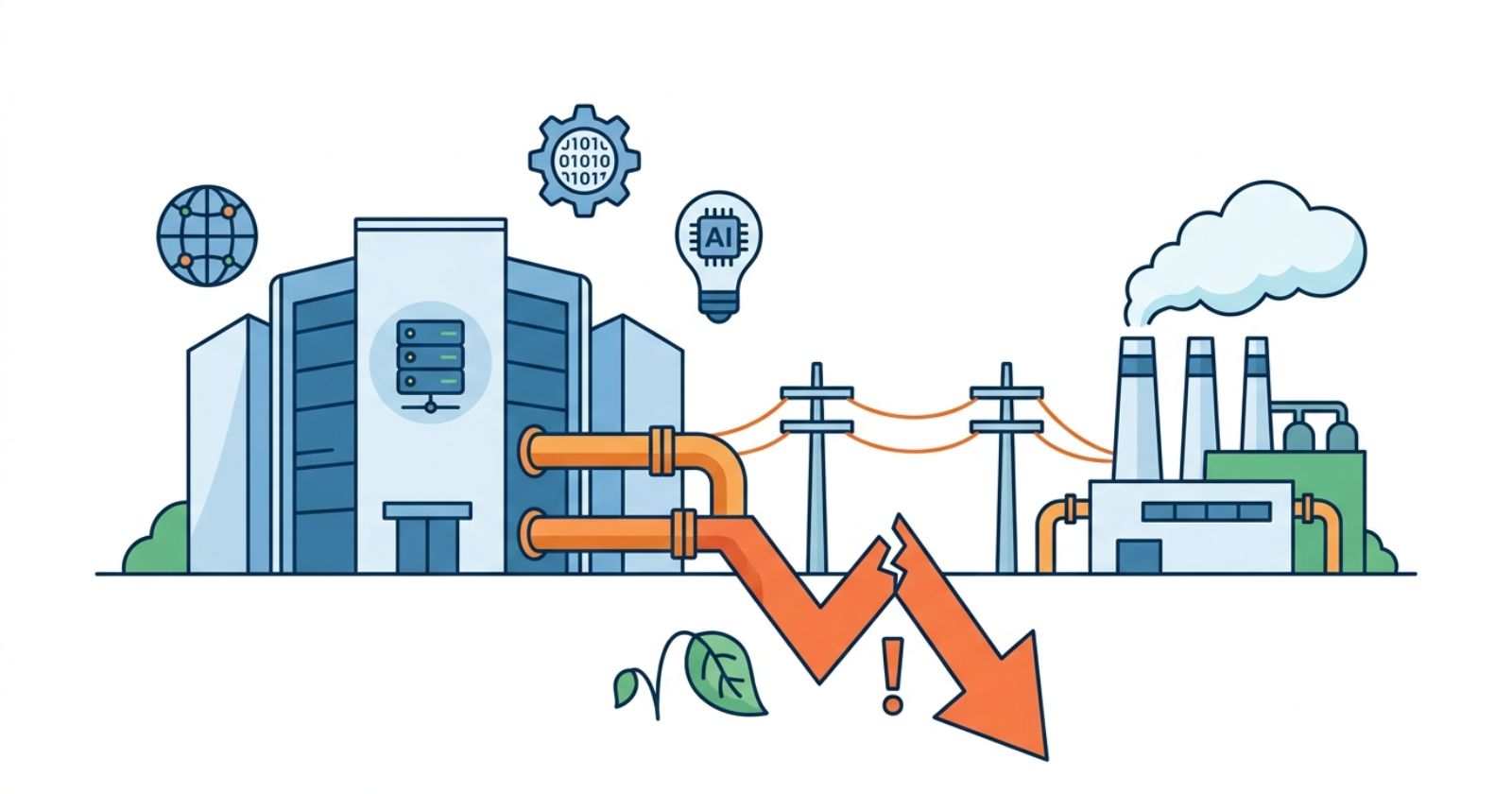
Tech companies once celebrated as clean-energy pioneers are now turning to natural gas to keep their artificial intelligence infrastructure running at full speed.
In the past week alone, Microsoft, Google, and Meta announced or expanded plans for large-scale natural gas-fired power plants tied directly to their data centers. The moves highlight the intense energy demands of AI training and inference, but they also expose the industry to supply constraints, price volatility, and mounting environmental criticism.
Scale of the New Gas Projects
The investments center in the southern United States, where vast shale gas reserves sit. Microsoft is partnering with Chevron and activist investment firm Engine No. 1 to develop a natural gas plant in West Texas that could reach 5 gigawatts of capacity. Google confirmed its collaboration with Crusoe Energy on a 933-megawatt facility in North Texas, part of the “Goodnight” data center campus in Armstrong County.
Meta is expanding its Hyperion data center in Louisiana by adding seven more natural gas plants, bringing the site’s total capacity to 7.46 gigawatts — roughly enough to power all of South Dakota.
These projects are not small supplements. They represent behind-the-meter generation that bypasses the traditional electric grid, allowing tech firms to secure reliable baseload power without competing directly for grid capacity.
| Company | Location | Capacity | Key Partner(s) |
|---|---|---|---|
| Microsoft | West Texas | Up to 5 GW | Chevron, Engine No. 1 |
| North Texas | 933 MW | Crusoe Energy | |
| Meta | Louisiana | 7.46 GW total | Not specified |
Why Natural Gas Now?
AI models require enormous amounts of electricity for both training and real-time operation. Industry leaders say renewable sources alone cannot yet deliver the constant, high-volume power needed for 24/7 data center clusters. Natural gas plants can be built faster than large solar or wind installations with battery storage, giving companies a quicker path to scale.
Yet the timing has raised eyebrows. Google, long viewed as a climate leader, had pledged carbon-free energy across its operations by 2030. That goal has quietly shifted to broader “climate moonshots,” and the company reported a 48 percent rise in greenhouse gas emissions since 2019, largely from data center growth.
The Texas plant alone is projected to emit up to 4.5 million tons of carbon dioxide annually — more than the city of San Francisco produces in a full year. Microsoft and Meta, which also maintain net-zero targets, face similar questions about their accelerating gas investments.
Supply Chain and Price Pressures Build
The sudden demand is already straining equipment markets. Turbine shortages mean prices could climb 195 percent by the end of 2026 compared with 2019 levels, according to energy consultancy Wood Mackenzie. New orders are not expected until 2028, and delivery times stretch to six years. Natural gas production growth in the nation’s three largest shale regions — which account for three-quarters of U.S. output — has slowed noticeably.
Even with plentiful domestic reserves, the resource is finite. The U.S. Geological Survey has noted that one major region holds enough gas to supply the entire country for about 10 months. Rapid expansion by data center operators could still push prices higher, especially if contracts do not lock in fixed rates long-term. Because natural gas generates roughly 40 percent of U.S. electricity, according to the Energy Information Administration, broader price swings would ripple across the grid.
Wider Impacts on Households and Industry
Tech companies argue that their behind-the-meter plants ease pressure on the public grid. Critics counter that the strategy merely shifts demand to the natural gas pipeline network. Other sectors — petrochemical manufacturing, for example — rely far more heavily on natural gas and lack easy renewable alternatives. A severe winter, like the 2021 Texas freeze that halted wellheads, could force suppliers to choose between heating homes and powering data centers.
Local communities near proposed sites have begun voicing concerns about emissions and land use. Investors, meanwhile, worry about stranded assets. Natural gas plants typically operate for 30 to 40 years, yet renewable costs continue to fall sharply. Facilities built today could become uneconomic within a decade if cheaper clean-energy options mature faster than expected.
A Calculated Gamble or a Costly Misstep?
The tech industry’s bet rests on two assumptions: that AI growth will remain exponential and that natural gas will serve as a dependable bridge until advanced renewables or other low-carbon sources catch up. Neither outcome is guaranteed. If AI efficiency improves rapidly or demand softens, companies could face expensive infrastructure they no longer need.
For now, the scramble reflects the raw physics of the digital economy. Data centers may live in the cloud, but they remain tethered to physical energy limits. By moving aggressively into natural gas, Microsoft, Google, and Meta are prioritizing speed in the AI race over their earlier environmental commitments.
Whether this proves a pragmatic interim solution or a long-term liability will depend on how quickly the industry can transition again — and how forgiving markets and regulators prove to be when the bills come due.