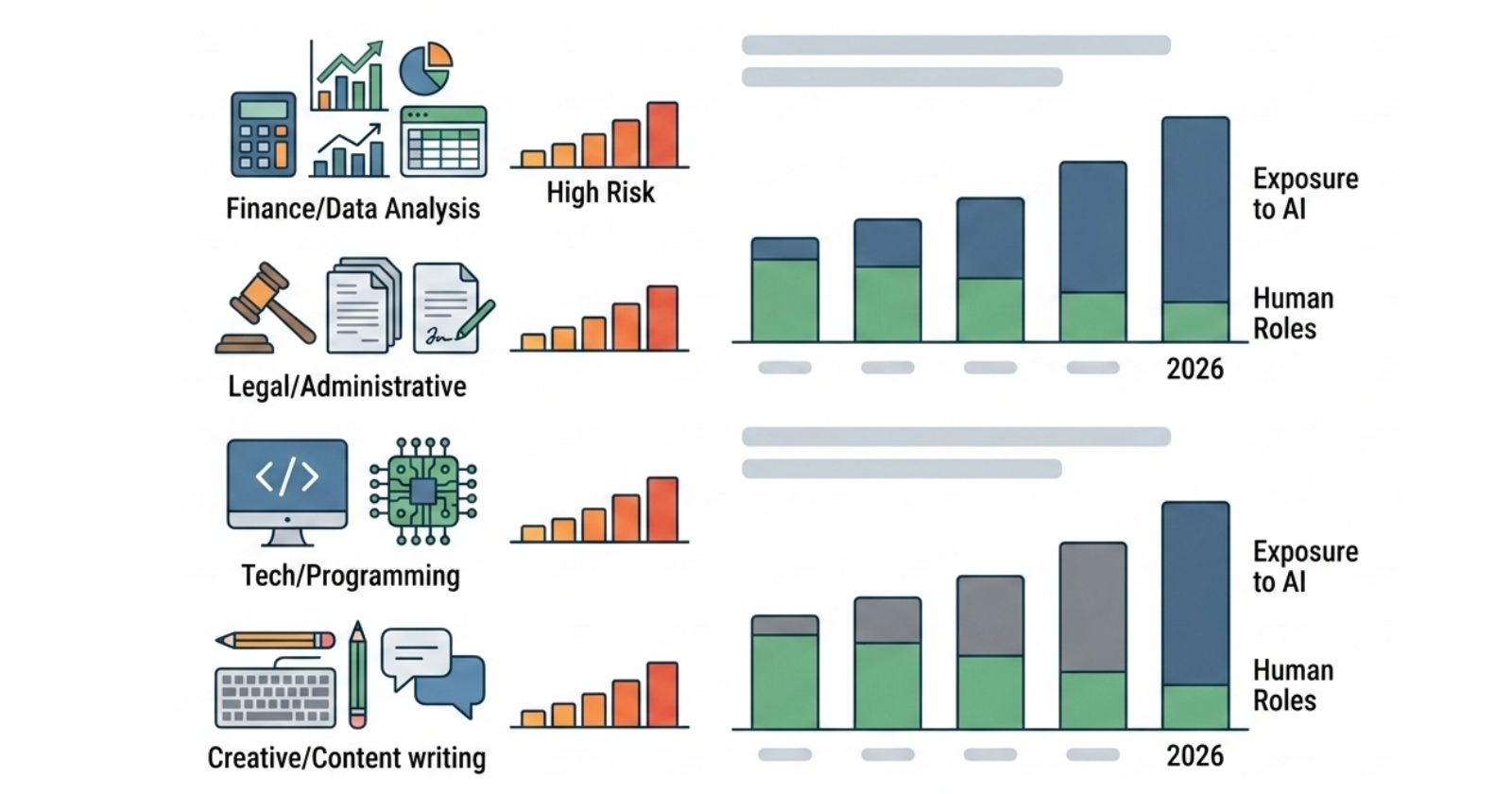
Anthropic’s groundbreaking research reveals a stark divide: artificial intelligence possesses the theoretical capacity to transform vast swaths of white-collar work, yet real-world adoption lags significantly behind potential.
Released in early March 2026, the study from Anthropic economists Maxim Massenkoff and Peter McCrory introduces “observed exposure,” a novel metric blending theoretical large language model capabilities with actual usage data from the company’s Claude AI tool. This approach highlights that while AI could accelerate tasks in fields like programming, finance, and administration, current professional applications remain a small fraction of what is feasible.
The findings arrive amid heightened concerns over AI-driven job disruption. Industry leaders, including Anthropic CEO Dario Amodei, have warned that the technology could upend half of entry-level white-collar positions in the coming years.
Similar cautions from Microsoft’s Mustafa Suleyman point to most professional roles facing replacement within 18 months. Yet the Anthropic analysis tempers these alarms with data-driven nuance, showing no widespread unemployment spike in exposed occupations since generative AI tools emerged in late 2022.
Understanding Observed Exposure: A New Lens on AI Risk
The report builds on prior frameworks, such as the 2023 Eloundou et al. study, which assessed theoretical LLM potential to at least double task speed. Anthropic advances this by incorporating real-world Claude interactions in work settings, prioritizing automated over augmentative uses and work-related contexts. Observed exposure quantifies the share of theoretically automatable tasks actually seeing AI deployment.
Theoretical capability covers high percentages in knowledge-based sectors: 94% for computer and mathematical roles, 90% for office and administrative support. In contrast, observed exposure remains modest, with Claude covering only 33% of tasks in computer and math occupations. This gap stems from barriers including model limitations, legal requirements, necessary supporting software, and mandatory human oversight.
For instance, physicians can theoretically authorize drug refills via AI, yet no such usage appears in Claude data. The discrepancy underscores that capability alone does not equate to immediate displacement.
Occupations Most Vulnerable to AI Disruption
The top exposed roles concentrate in knowledge and data-heavy fields, where language-based tasks dominate.
Top 10 Most Exposed Occupations (Observed Exposure Percentage):
- Computer Programmers: 75%
- Customer Service Representatives: 70%
- Data Entry Keyers: 67%
- Medical Record Specialists: 67%
- Market Research Analysts and Marketing Specialists: 65%
- Sales Representatives: 63%
- Financial and Investment Analysts: 57%
- Software Quality Assurance Analysts: 52%
- Information Security Analysts: 49%
- Computer User Support Specialists: 47%
(Source: Anthropic research report, March 2026)
These positions often involve reading, writing, analyzing, or processing information, areas where large language models excel. Computer programming leads due to extensive Claude usage in coding tasks, while customer service sees growing API-driven automation.
Conversely, about 30% of U.S. workers face zero observed exposure. Roles requiring physical presence or manual dexterity, such as cooks, motorcycle mechanics, lifeguards, bartenders, and dishwashers, remain largely untouched.
Demographics of the most exposed group differ markedly from those of the least exposed. Workers in high-exposure occupations are 16 percentage points more likely to be female, earn 47% more on average, and are nearly four times as likely to hold graduate degrees. They are also more likely to be white or Asian. This profile aligns with white-collar, higher-education professions historically seen as stable.
Early Labor Market Signals and Projections
Despite theoretical risks, aggregate data show limited immediate harm. Analysis of Current Population Survey unemployment trends reveals no systematic rise for highly exposed workers post-ChatGPT. Unemployment rates for the top exposure quartile and zero-exposure group have tracked similarly since late 2022, with any differential change small and statistically insignificant.
A potential early indicator emerges among younger workers aged 22 to 25. Job-finding rates in exposed occupations declined about 14% compared to 2022 levels, though the result borders on statistical significance. This slowdown in hiring, rather than outright layoffs, suggests companies may hesitate to fill entry-level roles in AI-vulnerable fields. Young entrants might stay in current positions, shift sectors, or pursue further education.
Cross-referencing with U.S. Bureau of Labor Statistics projections for 2024-2034 reinforces caution. Occupations with higher observed exposure show slightly weaker expected growth. For every 10 percentage point increase in coverage, BLS forecasts drop by 0.6 percentage points. This correlation validates the metric, as theoretical exposure alone shows no such link.
The broader context includes recent corporate actions. Companies like Block have cited AI-enabled efficiency in workforce reductions, though critics argue some reflect “AI washing” for unrelated cost-cutting. Federal Reserve officials and economists have outlined scenarios where AI adoption contributes to slower hiring or localized disruptions.
Potential for a White-Collar Recession?
The report contemplates a “Great Recession for white-collar workers,” akin to the 2007-2009 crisis when national unemployment doubled from 5% to 10%. A similar doubling in the top exposure quartile, from 3% to 6%, would register clearly in the framework. No such signal has appeared, but rapid capability advances and adoption could trigger it.
Historical parallels, from electricity eliminating lamplighter roles to computers obsoleting switchboard operators, remind that technological shifts reshape labor markets over time. Past offshorability predictions overestimated impacts, underscoring the need for humility in forecasting.
The researchers emphasize their framework as an evolving early-warning system. Periodic updates with fresh usage and employment data will better distinguish AI effects from business cycles or other forces.
As AI evolves, the gap between blue (theoretical) and red (observed) areas in exposure charts may narrow. Knowledge workers face adaptation pressure, while physical trades retain resilience. The transition demands policy attention to support reskilling, particularly for entry-level professionals entering a shifting landscape.
Anthropic’s analysis provides a measured perspective: disruption looms, but evidence of mass displacement remains absent. Vigilant monitoring will clarify whether AI heralds gradual evolution or sharper realignment in the American workforce.